🚛 FREE DISCREET SHIPPING ON ALL ORDERS $49+









How to Choose a Sleep Cart: Indica vs Hybrid vs CBD
There’s a particular kind of frustration that happens at 2 a.m. when your brain refuses to cooperate. You’ve tried the usual tricks – the chamomile tea, the phone face-down on the nightstand, maybe counting backward from three hundred. And now you’re staring at a vape cart on your bedside table, wondering if you grabbed the right one. Indica? Hybrid? That


There’s a particular kind of frustration that happens at 2 a.m. when your brain refuses to cooperate. You’ve tried the usual tricks – the chamomile tea, the phone face-down on the nightstand, maybe counting backward from three hundred. And now you’re staring at a vape cart on your bedside table, wondering if you grabbed the right one. Indica? Hybrid? That CBD-only option your friend swears by? Choosing a cart for sleep sounds simple until you’re actually standing in a dispensary being asked to decide between six different options with names like “Lunar Drift” and “Velvet Hammer.”
The honest truth is that the label on a vape cart tells you less than you think – and more than you’d expect – at the same time. Getting comfortable with what actually drives a relaxing, sleep-supportive experience comes down to understanding a few key things: how different cart types affect your body, what terpenes are doing behind the scenes, and why your own history with cannabis matters more than any general recommendation.
Why “indica vs hybrid” isn’t really the whole story
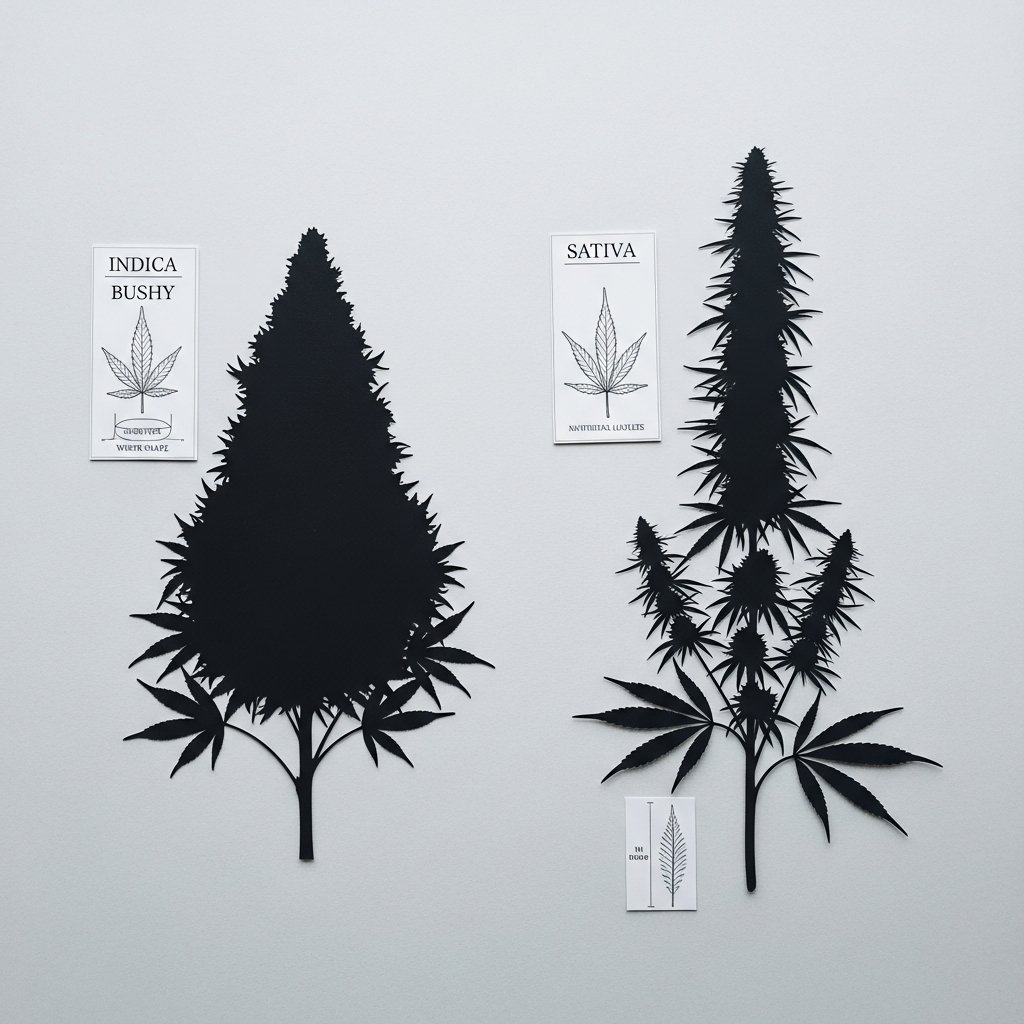
Here’s the thing most people don’t hear until they’ve already bought a few disappointing carts: the indica/sativa/hybrid classification system was designed to describe plant morphology, not your pharmacological experience. Indica plants are short and bushy; sativa plants are tall and narrow. That’s where the distinction started – with farmers and botanists, not neuroscientists.
Modern cannabis genetics have blurred these lines so thoroughly that calling something a “pure indica” is mostly marketing at this point. Nearly every commercially available cultivar has been crossed so many times that the chemical profile – meaning the actual cannabinoids and terpenes – matters far more than the category on the label. If you want to go deeper on how the classification landscape actually looks today, the complete guide to indica, sativa, and hybrid (modern science edition) is worth your time before you make another cart purchase.
That said, the categories still carry practical meaning at the dispensary counter, because producers use them as shorthand for the experience they’re trying to deliver. “Indica-leaning” carts are usually formulated to feel heavier and more physically sedating. “Hybrid” carts occupy a wide middle ground. And CBD-dominant carts work through a different mechanism entirely. So rather than throwing the labels out, it helps to know what each one is actually signaling.
What indica-leaning carts actually bring to bedtime

When a cart is labeled indica or indica-dominant, the producer is generally pointing you toward a terpene profile heavy in myrcene, linalool, and sometimes beta-caryophyllene. Myrcene, in particular, has a longstanding reputation for sedating effects – it’s the same compound found in hops, and some researchers have proposed it enhances the permeability of the blood-brain barrier to cannabinoids, though the human evidence is still emerging.
From a THC standpoint, indica carts often run high in potency because the target audience is looking for a pronounced, full-body effect. If you’re someone with a moderate-to-high tolerance, an indica cart before bed can feel like your muscles received a memo they’ve been waiting for all day. The downside? Go too heavy on THC and you might actually disrupt your REM sleep, which is the restorative deep phase your brain needs most.
Strains like Platinum Kush and Member OG represent the kind of cultivar profiles you’d expect to see in an indica-leaning sleep cart – dense, myrcene-forward, with a physical weight that many people associate with the “couch-lock” feeling. If you’ve enjoyed either of those strain profiles in flower, you’ll likely recognize a similar energy in a cart built around the same genetics.
Expert Insight
Dr. Alexander Tabibi
Dr. Alexander Tabibi
Research on myrcene and sedation is genuinely interesting but should be read carefully. A 2021 review published in Cannabis and Cannabinoid Research examined the proposed sedative properties of myrcene and found that while animal model data was suggestive, there is currently no robust controlled human trial confirming that myrcene directly induces sleep. The association you feel between “earthy, hoppy” cannabis and drowsiness is real, but the mechanism may involve synergistic interaction with THC rather than myrcene acting alone.
The more established concern is what high-dose THC does to sleep architecture over time. Multiple cohort studies have shown that regular high-THC use can suppress REM sleep duration. This may feel like better sleep short-term – fewer dreams, faster onset – but the longer-term picture for sleep quality is less favorable. For occasional use, a moderate-THC indica cart is unlikely to create problems; nightly high-dose use deserves more caution.
Babson K.A. et al. (2017). Cannabis, cannabinoids, and sleep: a review of the literature. Current Psychiatry Reports, 19(4):23. PMID: 28349316
Where hybrid carts fit into a sleep routine
Hybrid carts are, honestly, the most interesting category for sleep – because they’re the most variable. A hybrid cart could be 70% indica-leaning or 70% sativa-leaning, and the label won’t always tell you which. That’s why reading the terpene breakdown on the packaging matters more here than anywhere else. You can get a useful primer on decoding those numbers by checking out how to read cannabinoid and terpene percentages in a cannabis product listing.
For sleep specifically, you want a hybrid cart that tilts toward calming terpenes – linalool (which also shows up in lavender), terpinolene, and bisabolol – rather than energizing ones like limonene or pinene. The latter two are fine during the day but can work against you when you’re trying to wind down. Many hybrid carts designed for evening use will call this out explicitly in their descriptions, using words like “relaxing,” “body-forward,” or “nighttime.”
The practical upside of a good indica-leaning hybrid cart is that it often delivers a gentler experience than a straight indica – less of that “pinned to the mattress” heaviness, more of a quiet mental ease that lets you actually fall asleep rather than just feeling sedated. For people who find pure indicas too intense, or who want something that doesn’t completely knock out their cognitive function before they’ve even finished reading a chapter, a well-chosen hybrid cart often hits the right balance.
Cultivar profiles like Moon Pie and Motorbreath show up in hybrid carts aimed at the relaxation-to-sleep continuum – both carry that earthy, heavy-handed terpene signature without going fully sedative. If you recognize those names from a flower purchase you liked, a cart built on similar genetics is a reasonable place to start.
The case for CBD-dominant sleep carts
CBD carts occupy a completely different lane, and not just because they won’t get you high. CBD interacts with the endocannabinoid system in a way that’s less direct on the CB1 receptors that THC targets, which is why the experience feels less intoxicating and more like a gradual loosening of tension. For some people, that’s exactly what sleep requires. For others, it doesn’t feel like “enough.”
There’s also the anxiety question. A subset of people who use high-THC carts for sleep find that THC actually heightens anxiety rather than reducing it – especially if the dose is too high or the strain isn’t a good match for their biology. For those people, a CBD-dominant cart (sometimes with a small amount of THC in a roughly 10:1 or 20:1 CBD-to-THC ratio) can deliver the physical relaxation without the mental unpredictability. This is especially worth considering if you’re new to cannabis, sensitive to THC, or using a cart in a high-stress period of your life.
CBD carts also appeal to people in states or situations where THC isn’t accessible or advisable. They’re broadly available, often derived from hemp rather than cannabis, and carry a different legal and logistical profile. Just verify local rules before purchasing – hemp-derived CBD is federally legal in the U.S. under the 2018 Farm Bill, but individual state laws vary.
Expert Insight
Dr. Alexander Tabibi
Dr. Alexander Tabibi
The human trial evidence on CBD and sleep is modest but genuinely encouraging for certain subpopulations. A 2019 case series published in The Permanente Journal examined CBD use in 72 adults with anxiety and sleep complaints, finding that sleep scores improved in 66% of participants within the first month – though scores fluctuated afterward. It was a small, uncontrolled series, so broad conclusions require caution, but it aligns with anecdotal patterns clinicians frequently encounter.
What’s less discussed is the dose-dependency question. Some research suggests that CBD may have a biphasic effect on alertness – lower doses could be mildly activating for some individuals, while higher doses trend sedative. If you try a CBD cart and find you feel more awake rather than calmer, that’s not necessarily a product failure; it may reflect where you landed on that curve. Experimenting with timing and dose before committing to a nightly routine is worthwhile.
Shannon S. et al. (2019). Cannabidiol in anxiety and sleep: a large case series. The Permanente Journal, 23:18-041. PMID: 30624194
How to actually read a cart label before you buy
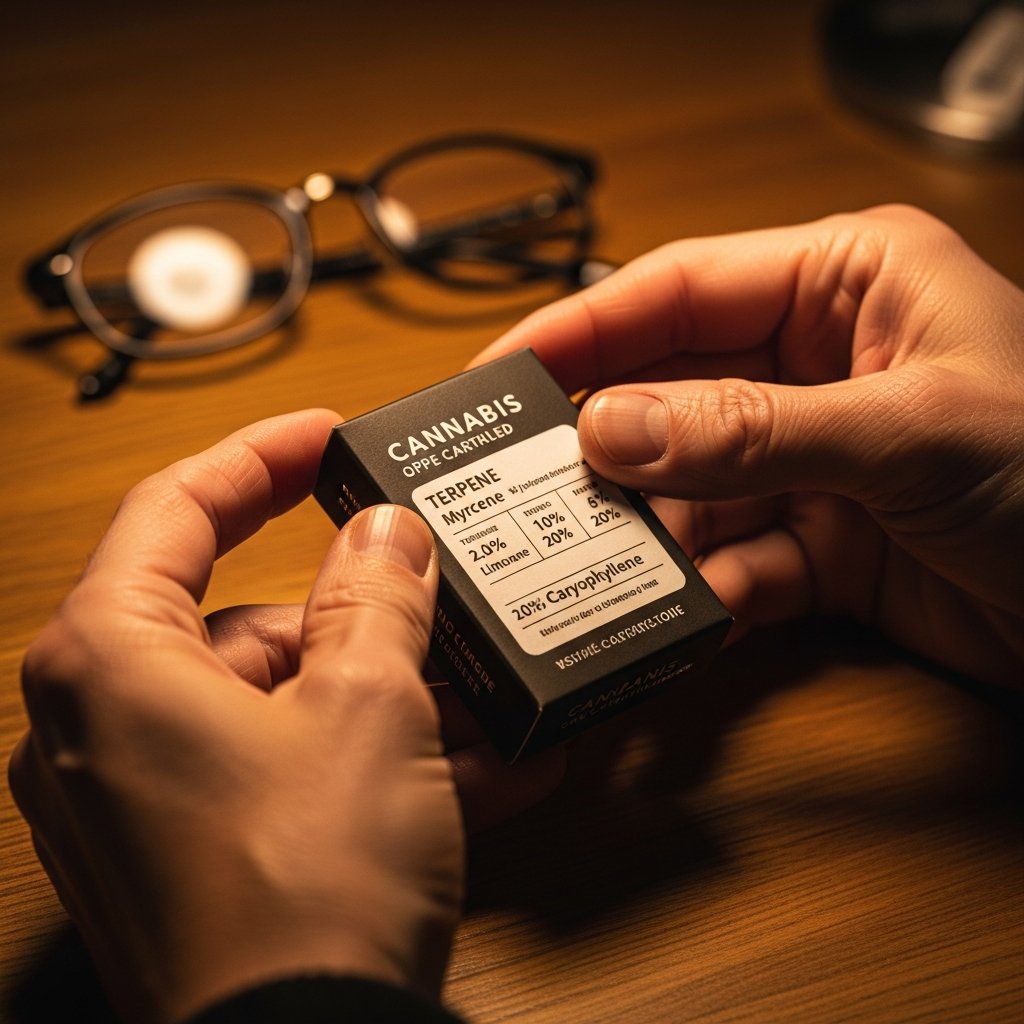
Let’s be honest – most people glance at the THC percentage and the category label and call it a decision. But if you’re buying specifically for sleep, three other numbers matter more. First, look at the myrcene percentage; anything above 0.5% in the terpene breakdown is meaningful. Second, check for linalool – even trace amounts contribute to the overall calming profile. Third, look at the total terpene percentage; carts with less than 5-6% total terpenes are often thin on flavor and effect alike.
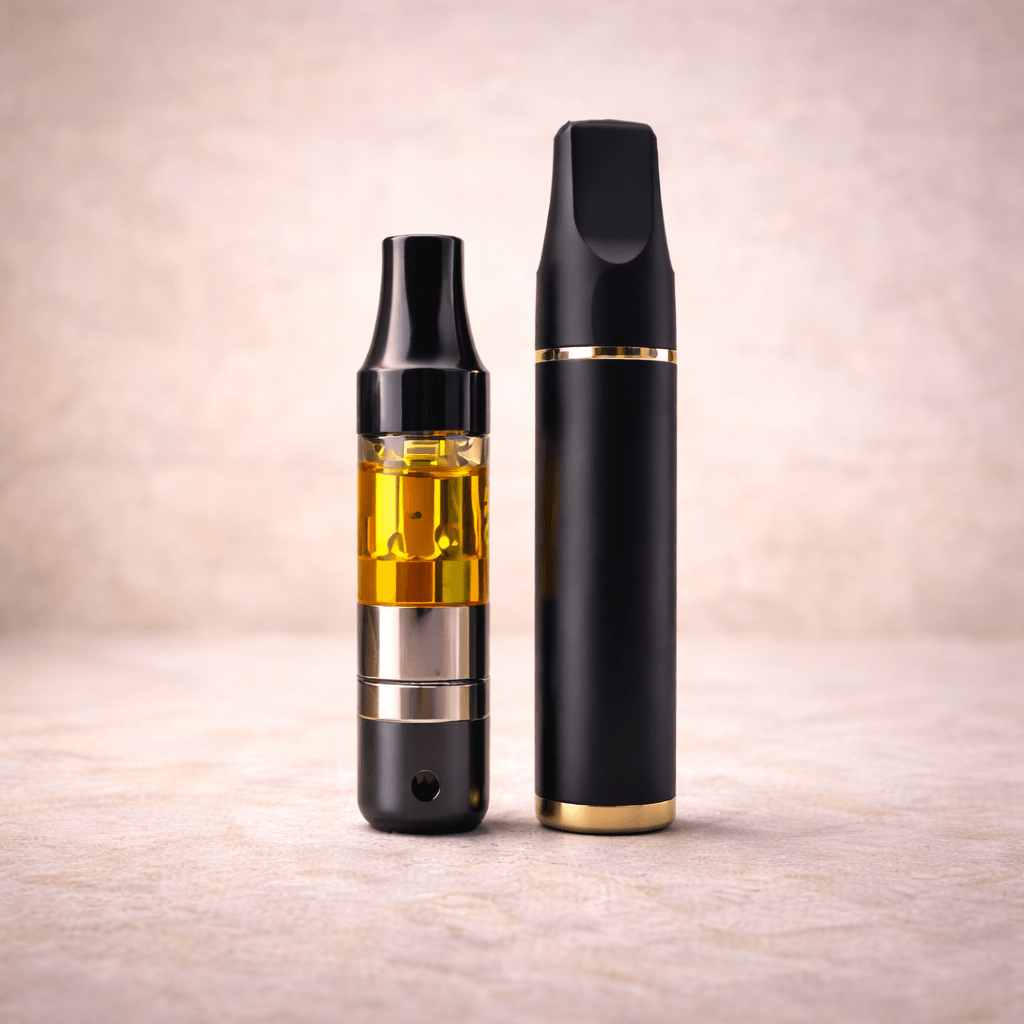
Beyond terpenes, hardware matters more than most guides admit. A cart with a ceramic coil and a variable voltage battery will preserve delicate terpenes better than a wick-based cart cranked to maximum heat. Lower temperature vaping (around 2.4-2.8 volts on most variable-voltage batteries) preserves the aromatic compounds that contribute to the experience you’re actually chasing.
If you’re trying to move from a flower-based sleep routine to carts, matching the strain genetics helps bridge the gap. Someone who’s had great nights with a Kush-lineage flower, for instance, would be well-served by a cart that explicitly names Kush genetics or a related OG profile. The experience won’t be identical – vaping has faster onset and often shorter duration than smoking – but the direction of the effect should feel familiar.
Matching your choice to your specific sleep challenge

Not everyone’s sleep problem looks the same, and choosing a cart type should reflect that. Trouble falling asleep often responds well to a moderate THC indica-leaning cart taken about 30-45 minutes before bed – enough lead time for the onset to align with lights out. Trouble staying asleep is a different puzzle; THC’s shorter duration means it may wear off before your most vulnerable wake-up windows, which is why some people prefer a 1:1 CBD-to-THC ratio or a CBD-dominant cart that sustains its effect longer without the sharp drop-off.
Stress-driven sleeplessness – the kind where your brain runs a highlight reel of everything you said awkwardly in 2019 – often benefits from the anxiolytic terpene profiles found in certain hybrid and CBD carts. Linalool and beta-caryophyllene both have proposed calming mechanisms. Understanding which specific cultivar tendencies match your patterns is part of why resources like the overview of how to choose the right cannabis strain for your needs can save you a few expensive trial runs at the dispensary.
One more honest note: if you’re relying on a cart every single night to fall asleep, it’s worth looping in a healthcare provider about your sleep patterns. Cannabis can be a useful tool; it works best as part of a broader sleep hygiene approach rather than as the only strategy.
Frequently asked questions
Is an indica cart or a hybrid cart better for sleep?
It depends on your tolerance and what kind of sleep trouble you have. Indica-leaning carts typically deliver heavier physical sedation; hybrid carts offer a gentler effect that many people find easier to fall asleep on without feeling overloaded. Terpene profile matters more than the category label alone.
Can a CBD cart actually help you sleep?
For some people, yes – particularly those whose sleep issues are anxiety-driven. Evidence from small studies suggests CBD may help reduce sleep-disrupting anxiety. Results vary by dose, and CBD can feel mildly energizing at lower doses for some individuals, so expect a bit of personal calibration.
What terpenes should I look for in a sleep cart?
Myrcene, linalool, and beta-caryophyllene are the three most commonly associated with relaxation and sleep support. Look for these in the terpene breakdown on the cart’s packaging or lab certificate. Avoid carts high in limonene or alpha-pinene if you’re using them close to bedtime.
Does high THC in a vape cart improve sleep quality?
High THC can speed up sleep onset, but research suggests regular high-dose THC use may reduce REM sleep over time. Occasional moderate use is less concerning, but nightly heavy use may affect sleep architecture in ways that aren’t immediately obvious.
How long before bed should I use a sleep cart?
Most people find 30 to 45 minutes before their target sleep time works well for a vape cart, since inhalation onset is fast (5-15 minutes) but peak effects take a little longer to settle. Starting with 1-2 small puffs and waiting before taking more is the most reliable approach.
Why does the same cart affect me differently on different nights?
Stress levels, recent food intake, hydration, and even the time of day all influence how cannabis metabolizes in your system. A cart that worked beautifully after a calm evening may feel different after a stressful day – that’s normal biological variability, not a product defect.
If you take prescription medications, speak with your pharmacist or physician before using cannabis products, especially if those medications affect your central nervous system or sleep cycle.
Sources
- Babson K.A., Sottile J., Morabito D. (2017). Cannabis, cannabinoids, and sleep: a review of the literature. Current Psychiatry Reports, 19(4):23. PMID: 28349316
- Shannon S., Lewis N., Lee H., Hughes S. (2019). Cannabidiol in anxiety and sleep: a large case series. The Permanente Journal, 23:18-041. PMID: 30624194
- Russo E.B. (2011). Taming THC: potential cannabis synergy and phytocannabinoid-terpenoid entourage effects. British Journal of Pharmacology, 163(7):1344-1364. PMID: 21749363
- Kaul M., Zee P.C., Bhatt D.L. (2021). Effects of cannabinoids on sleep and their therapeutic potential for sleep disorders. Neurotherapeutics, 18(1):217-227. PMID: 33511583
- Murillo-Rodriguez E. et al. (2014). Potential effects of cannabidiol as a wake-promoting agent. Current Neuropharmacology, 12(3):269-272. PMID: 24851090
For adults 21+ only. Cannabis laws vary by state. This article is for informational purposes only and does not constitute medical advice. If you are experiencing a medical emergency, call 911 or go to your nearest emergency room immediately. Consult a qualified healthcare provider before making changes to your health routine.