🚚 Free Discreet Shipping on Orders $49+ | Lab-Tested Quality Guaranteed









The Complete Cannabinoid Legality Guide (Federal + State Breakdown)
Published on December 1, 2025
Last Updated on January 6, 2026
By Raven Ballou
Introduction
The cannabis landscape in the United States is more complicated than ever. What used to be a simple distinction — hemp is legal, marijuana is not — has evolved into an intricate web of federal loopholes, state-specific restrictions, chemically converted cannabinoids, “total THC” math, and competing interpretations of the Farm Bill.
By 2025, more than a dozen cannabinoids have entered the market — Delta-8, Delta-10, THCP, HHC, THCV, CBC, CBN, and high-THCA hemp flower — each with its own legal gray areas. At the same time, states continue tightening regulations while federal agencies debate whether hemp-derived THC should remain legal at all.
This guide breaks down how cannabinoid legality actually works today, what the federal government allows, how states differ, why “farm-bill-compliant THC” is controversial, and what consumers and businesses need to know moving forward.
What the Law Actually Says
Cannabinoid legality revolves around two key definitions:
1. The 2018 Farm Bill Definition of Hemp
Hemp is:
“Cannabis sativa L. and any part of that plant, including seeds, extracts, cannabinoids… with Δ9-THC concentration not more than 0.3% on a dry weight basis.”
This definition matters because:
-
It legalized all hemp cannabinoids.
-
It covers extracts, derivatives, and isomers.
-
It does not limit THCA as long as Δ9 THC remains ≤0.3%.
-
It created the legal foundation for Delta-8, THCA flower, and other hemp intoxicants.
2. The Controlled Substances Act (CSA)
The CSA classifies “marijuana” as cannabis containing more than 0.3% Delta-9 THC.
It also classifies Delta-9 THC itself as a Schedule I substance.
This means:
-
Delta-9 from cannabis is federally illegal.
-
The same molecule from hemp is legal if Δ9 THC remains ≤0.3%.
The Loop Between the Two
The Farm Bill removed hemp from the CSA.
So cannabinoids produced from hemp — even intoxicating ones — are not controlled substances under federal law unless Congress changes the definition.
This is why hemp THCA flower, Delta-8 vapes, and THCP disposables exist today.
Federal vs. State Power: Who Controls What?
Cannabis legality in the U.S. is a dual-authority system.
Federal Government Controls:
-
The definition of hemp
-
Interstate commerce
-
FDA rules for ingestible products
-
DEA enforcement
-
Customs & import authority
-
Scheduling of controlled substances
States Control:
-
Whether intoxicating hemp cannabinoids are allowed
-
THC limits for products sold in-state
-
Age restrictions
-
Retail licensing
-
Lab testing and packaging rules
-
Prohibitions on Delta-8, Delta-10, THCP, HHC, etc.
This means a hemp product can be:
-
federally legal
-
legal to ship across states
-
illegal to possess or sell within a specific state
This is the core of the confusion.
The Current Federal View of Popular Cannabinoids
Delta-9 THC
-
Legal if hemp-derived and ≤0.3% Δ9 THC by dry weight
-
Illegal if marijuana-derived or >0.3%
-
Legal for adult-use in recreational states
-
Legal medically in medical-only states
THCA (Tetrahydrocannabinolic Acid)
-
Legal federally as long as Δ9 THC remains ≤0.3%
-
Not classified separately under CSA
-
Converts to THC when heated
-
States increasingly regulate total-THC (THCA × 0.877)
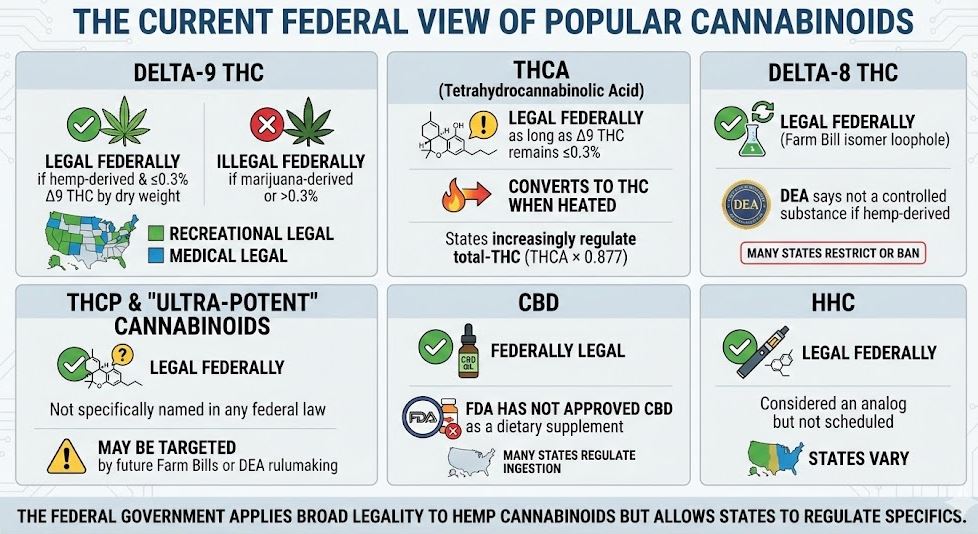
Delta-8 THC
-
Legal federally (Farm Bill isomer loophole)
-
DEA says it is not a controlled substance if hemp-derived
-
Many states restrict or ban it
THCP & “ultra-potent” cannabinoids
-
Legal federally
-
Not specifically named in any federal law
-
May be targeted by future Farm Bills or DEA rulemaking
CBD
-
Federally legal
-
FDA has not approved CBD as a dietary supplement
-
Many states treat CBD gently but still regulate ingestion
HHC
-
Legal federally
-
Considered an analog but not scheduled
-
States vary
The federal government applies broad legality to hemp cannabinoids but allows states to regulate specifics.
Why States Treat Cannabinoids Differently
States differentiate cannabinoids based on:
1. Intoxication Level
Non-intoxicating cannabinoids (CBD, CBG, CBC) are rarely restricted.
Intoxicating cannabinoids (Delta-8, THCA flower, THCP) face bans or heavy regulation.
2. Public Safety Concerns
States worry about:
-
teen access
-
gas-station sales
-
inconsistent lab testing
-
residual solvent contamination
-
“synthetic” conversions
3. Cannabis Industry Pressure
Licensed cannabis operators often lobby against intoxicating hemp products because they see them as competition.
4. Law Enforcement Simplicity
THCA flower looks and smells identical to marijuana.
Many states choose to regulate it to avoid enforcement conflict.
5. “Total THC” Interpretation
Some states test cannabis using the formula:
Total THC = Δ9 + (THCA × 0.877)
This instantly makes nearly all THCA flower “marijuana” under state law.
Together, these factors explain why legal maps vary dramatically.
Understanding the “Total THC” Standard
Total THC is the most important regulatory trend in cannabinoid law. States adopting this standard treat THCA the same as THC because it becomes THC when heated (decarboxylation).
Why states use total THC:
-
Prevents selling cannabis-strength flower as “hemp”
-
Aligns state hemp programs with international standards
-
Simplifies enforcement for police and regulators
Impact:
-
High-THCA flower becomes illegal in total-THC states
-
Farm-bill cultivators must use earlier harvest windows
-
Retailers must test frequently to stay compliant
This is one of the main reasons THCA legality changes rapidly from state to state.
Are Chemically Converted Cannabinoids Legal?
Cannabinoids like Delta-8, Delta-10, THC-O and THCP are often made through isomerization, converting CBD into another compound.
Federal Status
DEA states:
If the cannabinoid is hemp-derived and not explicitly scheduled, it is federally legal.
But…
The “Federal Analog Act” can apply if:
-
the cannabinoid is too structurally similar to THC
-
it was intended for human consumption
-
it produces comparable effects
Because no federal agency has enforced this yet, these cannabinoids remain in a legal gray zone but still widely sold.
Enforcement Trends in 2024–2025
Several key trends define the emerging legal environment:
1. Increased Lab Testing Requirements
States now require:
-
full panel COAs
-
residual solvent tests
-
total THC calculations
-
age-gating
2. Greater Restrictions on Shipping
More states prohibit accepting hemp-THC packages from out-of-state retailers.
3. Crackdowns on Gas-Station & Convenience Store Sales
Regulators are increasingly moving intoxicating hemp behind age-gated counters or into licensed dispensaries.
4. Lawsuits Over Delta-8 and THCA
State-level lawsuits continue to shape legality, with courts sometimes ruling in favor of hemp businesses based on federal law.
5. Farm Bill Delays
Congress has repeatedly delayed the new Farm Bill, leaving the industry in limbo.
How Medical vs. Recreational States Differ
Cannabinoid legality becomes far easier to understand once you recognize that the United States operates under three distinct cannabis systems: recreational states, medical states, and prohibition states. Each group uses a different regulatory philosophy, shaped by political priorities, economic interests, public health concerns, and how established their cannabis programs are. These differences explain why a product that is fully legal in one state may be heavily restricted—or even banned—just a few miles away.
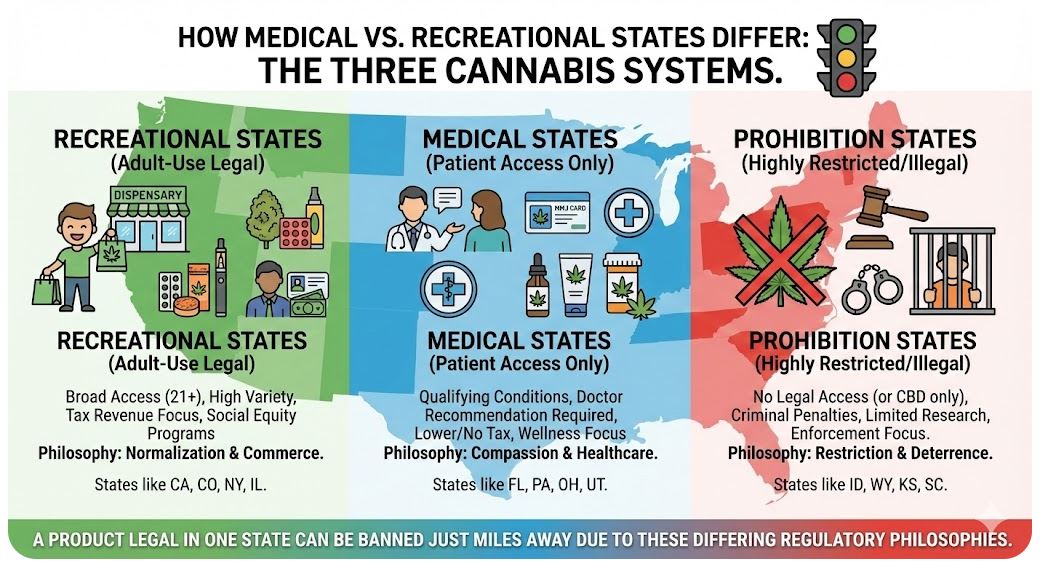
Recreational Cannabis States: Broad Access, High Regulation
Recreational (adult-use) states tend to be the most permissive because they already have a comprehensive, licensed cannabis industry. Consumers can legally purchase high-potency THC products from regulated dispensaries, and the state collects substantial tax revenue from these sales. Because the regulated market already offers potent products, many recreational states choose to restrict Delta-8, THCA flower, or conversion-based cannabinoids not due to safety concerns, but because the marijuana industry sees these products as unregulated competition.
In these states, the cannabis ecosystem is designed around tested, taxed, and traceable marijuana—not around hemp derivatives. As a result, intoxicating hemp often faces tighter oversight or outright bans, even though the same molecules are available over the counter inside licensed dispensaries.
Medical Cannabis States: A Patchwork of Policies
Medical states form the most inconsistent category. Because their cannabis markets are only partially developed, each state draws different lines between “medical marijuana,” “regulated hemp,” and “intoxicating hemp derivatives.” Some medical states restrict Delta-8 and THCA flower to protect medical dispensary revenue, arguing that high-THC hemp undermines their program’s integrity. Others take a more permissive stance, allowing hemp-derived cannabinoids as long as they comply with federal 0.3% Δ9 THC limits.
This creates a mixed environment where patients may legally access cannabis-derived THC in dispensaries but find hemp-derived equivalents banned—or vice versa.
Prohibition States: Strict Limits, Narrow Exceptions
Prohibition states, which have neither recreational nor medical cannabis programs, usually take the strictest approach. These states frequently ban Delta-8, Delta-10, THCP, HHC, and high-THCA flower because they view intoxicating hemp as an attempt to bypass marijuana laws. Most also adopt total-THC testing, instantly classifying nearly all THCA flower as illegal “marijuana” under state law.
However, even prohibition states typically allow CBD, recognizing it as non-intoxicating and federally legal. As a result, the hemp market in prohibition states often consists of CBD oils, balms, topicals, and low-THC wellness products—but little else.
The Three Americas
These differences create what many legal experts describe as “three Americas”:
-
Legal states, where THC is fully regulated.
-
Medical states, where THC access depends on patient status.
-
Hemp-only states, where nearly all intoxicating cannabinoids are restricted.
Understanding which category your state falls into is essential for staying compliant—and for predicting how laws may evolve in the future.
How Online Sales Work (What’s Actually Allowed)
Even if a product is federally legal, online sales depend on:
-
state purchase restrictions
-
shipping carrier policies
-
age verification technology
-
COA availability
-
packaging laws
-
potency caps
Retailers must maintain dynamic compliance systems because the legal map changes monthly.
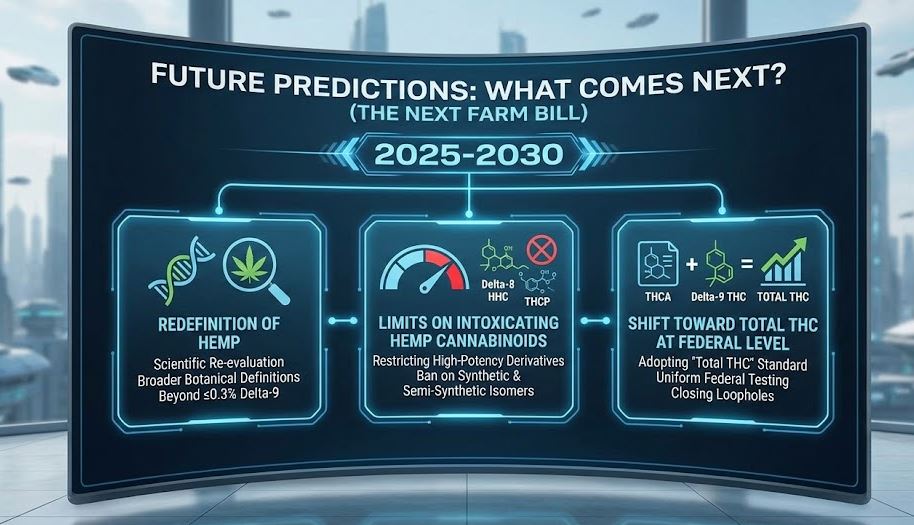
Future Predictions: What Comes Next?
1. The Next Farm Bill
Expect:
-
a redefinition of hemp
-
limits on intoxicating hemp cannabinoids
-
a shift toward total THC at the federal level
-
new potency caps
2. Stricter Age Verification Requirements
Online sales will likely require:
-
ID scanning
-
biometric verification
-
adult-signature delivery
3. Federal Crackdown on Conversions
The DEA may target isomerization labs or impose additional safety requirements.
4. THCA Flower Regulation
Most experts expect THCA flower to face new restrictions or be reclassified.
5. National Standards for Lab Testing
A unified “USP-like” cannabis testing standard may emerge.
6. Cannabis Rescheduling
If cannabis moves from Schedule I to Schedule III or descheduled entirely, the hemp–cannabis distinction could shift dramatically.
Consumer Guide: How to Stay Legal Personally
Check your state laws monthly
Cannabinoid laws change more frequently than any other consumer regulation.
Keep product packaging & COAs
If stopped by police, lab reports help show the product is hemp-based.
Avoid traveling across prohibited states
Even federally compliant hemp can be seized in certain jurisdictions.
Be aware of “impairment” laws
Intoxication is illegal even if the cannabinoid is legal.
Business Guide: How Brands Stay Compliant
For cannabinoid brands, compliance in 2025 is no longer a simple checklist — it is a fully integrated operational framework that determines whether a company can survive in an increasingly regulated industry. Because state laws shift rapidly and federal guidance remains inconsistent, brands must operate with real-time adaptability and rigorous documentation. Compliance today is equal parts legal intelligence, supply-chain transparency, and consumer safety assurance.
The first step is maintaining real-time state compliance mapping. Laws governing Delta-8, THCA flower, intoxicating hemp, and converted cannabinoids change monthly, sometimes weekly. Successful brands now use automated systems or third-party compliance platforms that track state restrictions, possession limits, shipping bans, testing requirements, and age-gating rules. Without this, a brand risks unintentionally selling into a prohibited market — one of the fastest ways to trigger enforcement action.
Age-verification systems are the next essential layer. States increasingly require robust age checks for online orders, including ID scanning, two-step verification, and adult-signature delivery. Relying on simple “Are you 21?” pop-ups is no longer sufficient. Retailers must show regulators they made reasonable efforts to prevent youth access.
QR-coded COAs (Certificates of Analysis) have become standard, providing instant access to lab results for every SKU. These must verify potency, total-THC compliance, residual solvents, pesticides, heavy metals, and microbial safety. Leading brands also use batch-level testing, ensuring every production run has its own traceable report.
Packaging and labeling are equally critical. Child-resistant, tamper-evident packaging is required in most regulated markets. Labels must include accurate cannabinoid content, serving size, ingredient lists, warnings, manufacturing details, and scannable COA links. Mislabeling — even unintentionally — is now one of the top cited violations in compliance audits.
In 2025, cannabinoid compliance isn’t about avoiding penalties; it’s about demonstrating legitimacy, consumer safety, and operational maturity. Brands that take compliance seriously build trust, withstand regulatory tightening, and position themselves as long-term leaders in a rapidly evolving marketplace.
Final Summary
The cannabinoid legal landscape is a constantly shifting ecosystem shaped by federal loopholes, state sovereignty, commercial pressure, and scientific innovation. Hemp cannabinoids remain federally legal thanks to the 2018 Farm Bill, but states increasingly impose restrictions — especially on intoxicating products like Delta-8, THCA flower, THCP, and HHC.
Understanding legality today requires understanding:
-
the federal hemp definition
-
the Controlled Substances Act
-
state-level total-THC rules
-
intoxicating vs. non-intoxicating cannabinoids
-
enforcement priorities
-
future Farm Bill changes
Consumers, brands, and healthcare providers must stay informed, because the cannabinoid world of 2025 will not look the same in 2026.