🚚 Free Discreet Shipping on Orders $49+ | Lab-Tested Quality Guaranteed









The Complete Guide to Cannabis Bioavailability
Published on December 1, 2025
Last Updated on January 6, 2026
By Raven Ballou
Introduction
Cannabis can feel dramatically different from one person to another — and even from one product to the next. Two people can take the same edible, the same vape, or the same tincture, yet experience completely different effects. Some feel nothing. Some feel everything. And some feel too much.
Most consumers assume this is because of “tolerance.” In reality, bioavailability is the real driver.
Bioavailability refers to how much of a cannabinoid actually makes it into your bloodstream and becomes active in your body. You may think you’re taking 10 mg of THC, CBD, or CBN — but depending on the product format, your body may only absorb 4–35% of it. That’s a huge difference, and it explains why the same dose can be mild in one format and intense in another.
As the cannabis market expands — edibles, tinctures, nano-emulsions, THCA flower, vapes, dabs, tablets, beverages, and more — understanding bioavailability has become essential. This guide breaks down everything you need to know: how different cannabinoids are absorbed, which formats hit hardest, which last longest, how your metabolism influences effects, and how to use science to control your experience with precision.
By the end, you’ll know exactly why cannabis feels the way it does — and how to make every dose more predictable, efficient, and enjoyable.
What Bioavailability Means (Science Explained Simply)
Bioavailability is the percentage of a cannabinoid that successfully reaches your bloodstream and becomes usable by your body.
If you consume 10 mg THC, but your body only absorbs 2 mg, your bioavailability is 20%.
Cannabinoids must travel through biological barriers — the stomach, liver, lungs, or skin — and these barriers determine how much survives. Every method of consumption has its own path in the body, which dramatically changes the strength, timing, and duration of effects.
Why bioavailability matters
-
It determines how strong a dose feels
-
It affects how long effects last
-
It influences how much you need to take
-
It helps explain why one format works better for pain vs. anxiety vs. sleep
-
It prevents accidental overconsumption
Bioavailability is the secret key to understanding cannabis.
Why Bioavailability Varies So Widely
Cannabinoids are fat-loving molecules (lipophilic). This means:
-
They dissolve easily in oils
-
They don’t dissolve easily in water
-
They pass quickly through fatty membranes
-
They break down slowly
Because of this, the body absorbs cannabinoids better when they travel with oils, fats, emulsifiers, or nano-carriers. Without these, most cannabinoids pass through the digestive system without being absorbed at all.
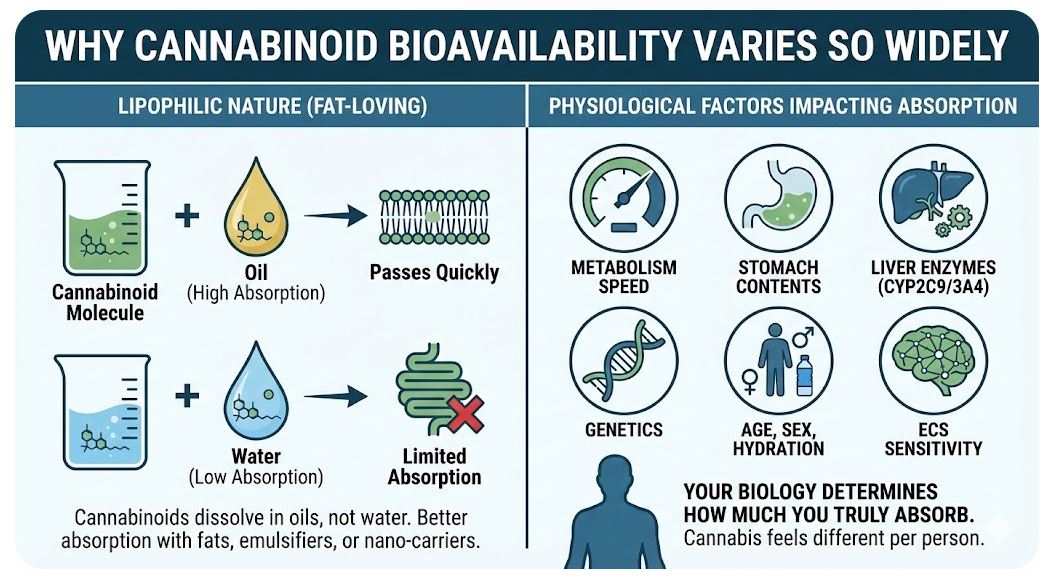
Other factors that impact bioavailability include:
-
metabolism speed
-
stomach contents
-
liver enzyme activity
-
genetics (CYP2C9 and CYP3A4 variants)
-
age, sex, hydration
-
your personal endocannabinoid system sensitivity
This is why cannabis feels different from person to person — your biology determines how much you truly absorb.
Bioavailability by Product Type (Highest to Lowest)
Below is a detailed breakdown of how each cannabis format enters your bloodstream, including approximate bioavailability percentages based on human pharmacokinetic studies.
Vaping & Smoking (Bioavailability: 25–35%)
How it works
Inhaled cannabinoids enter the lungs, cross the alveoli membrane, and go directly into the bloodstream. This bypasses the liver, giving you fast, strong effects.
What to expect
-
Onset: 1–3 minutes
-
Peak: 10–15 minutes
-
Duration: 1–3 hours
Why it’s strong
Nearly one-third of all inhaled THC becomes active — one of the highest absorption rates of any cannabis format.
Limitations
-
Not ideal for long-lasting overnight relief
-
Irritation risk for sensitive lungs
-
Terpenes degrade through combustion
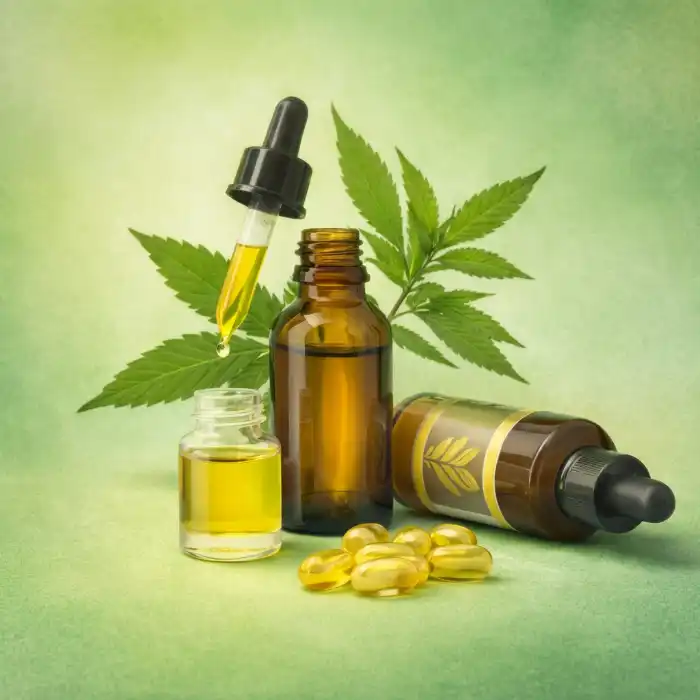
Sublingual Tinctures (Bioavailability: 10–25%)
How it works
Placed under the tongue, tinctures absorb through mucous membranes into the bloodstream. For maximum efficiency, they must be held under the tongue for 60–90 seconds.
What to expect
-
Onset: 20–45 minutes
-
Duration: 4–6 hours
Strength
Tinctures bypass some of the liver’s first-pass metabolism, meaning more cannabinoids survive the journey.
Limitations
-
Swallowing too early reduces bioavailability
-
Oil-based tinctures absorb slower than nano-emulsions
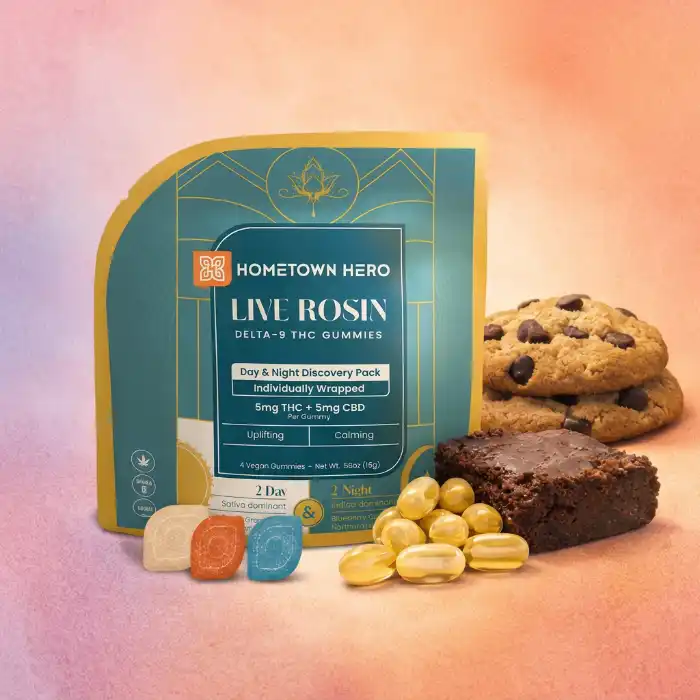
Edibles (Bioavailability: 4–12%)
How it works
Edibles must pass through the stomach and liver. The liver converts THC into 11-hydroxy-THC, a stronger and longer-lasting metabolite.
What to expect
-
Onset: 45–120 minutes
-
Duration: 6–10 hours
Why edibles feel intense
Even though their bioavailability is low, the 11-hydroxy metabolite is 2–3× stronger than inhaled THC.
Limitations
-
Slow onset
-
Difficult dosing for beginners
-
Inconsistent absorption when taken with or without food
Nano-Emulsified Beverages (Bioavailability: 15–40%)
How it works
Nano beverages use microscopic cannabinoid droplets coated with emulsifiers. These dissolve in water and absorb quickly through stomach and intestinal lining.
What to expect
-
Onset: 10–20 minutes
-
Duration: 2–4 hours
Advantages
-
Highly predictable
-
Faster than traditional edibles
-
Higher absorption efficiency
Limitations
-
Bitter flavor in poorly formulated products
-
Not all “nano” products are truly nanosized
Capsules & Softgels (Bioavailability: 5–15%)
How it works
Capsules dissolve in the stomach, and oils carry cannabinoids through the digestive tract.
What to expect
-
Onset: 45–90 minutes
-
Duration: 6–8 hours
Advantages
-
Highly consistent
-
Ideal for daily therapeutic use
-
No flavor issues
Limitations
-
Must pass through full digestion
-
Lower absorption than tinctures
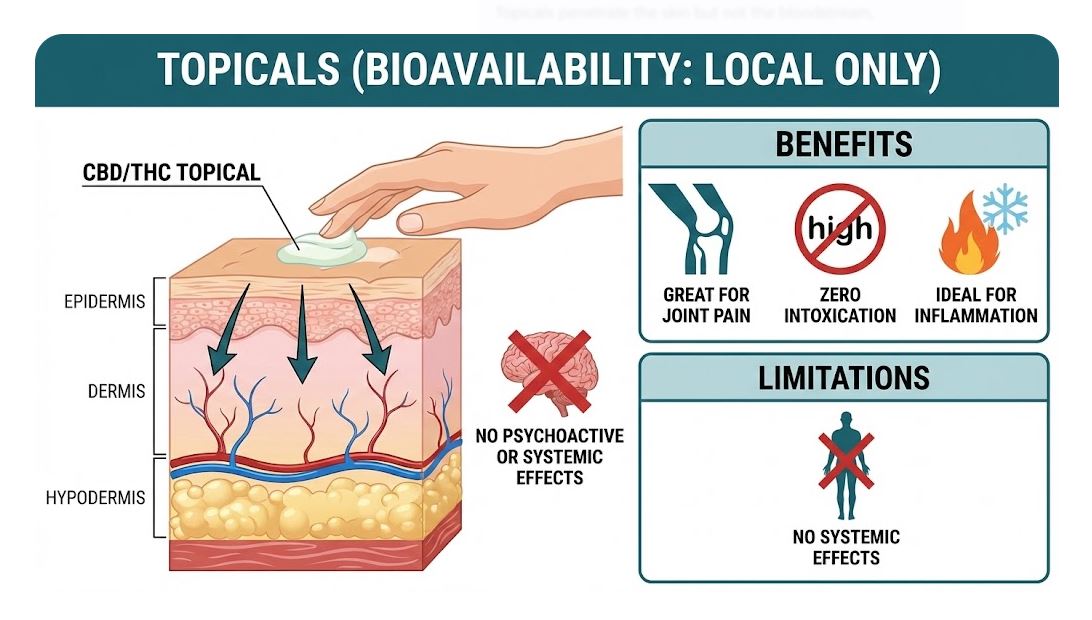
Topicals (Bioavailability: Local only)
How it works
Topicals penetrate the skin but not the bloodstream, meaning they only treat the local area.
Benefits
-
great for joint pain
-
zero intoxication
-
ideal for inflammation
Limitations
-
No psychoactive or systemic effects
Transdermal Patches (Bioavailability: 30–50%)
How it works
Transdermal patches push cannabinoids through skin layers into the bloodstream using permeation enhancers.
Advantages
-
extremely long duration (8–48 hours)
-
steady, controlled release
-
medical-level consistency
Limitations
-
slower initial onset
-
pricier than other formats
Bioavailability Table by Product Type
A quick reference table:
| Format | Bioavailability | Onset | Duration |
|---|---|---|---|
| Smoking | 25–30% | 1–3 min | 1–3 hrs |
| Vaping | 30–35% | 1–3 min | 1–3 hrs |
| Sublingual tinctures | 10–25% | 20–45 min | 4–6 hrs |
| Edibles | 4–12% | 45–120 min | 6–10 hrs |
| Nano-beverages | 15–40% | 10–20 min | 2–4 hrs |
| Capsules/softgels | 5–15% | 45–90 min | 6–8 hrs |
| Topicals | Local only | N/A | N/A |
| Transdermal patches | 30–50% | 20–60 min | 8–48 hrs |
Factors That Affect Your Personal Bioavailability
Even though bioavailability charts give general percentages, the way cannabinoids absorb in your body is highly individual. Two people can take the same product, at the same dose, at the same time — and still experience completely different effects. This variability is driven by a number of physiological and metabolic factors that influence how efficiently cannabinoids enter the bloodstream, how long they stay active, and how strongly they are felt.
1. Metabolism Speed
People with faster metabolisms absorb and eliminate cannabinoids more quickly. Their bodies process edibles or tinctures rapidly, causing effects to appear sooner but fade faster. Slower metabolizers experience the opposite: delayed onset, stronger intensity, and longer duration. This is why one user might feel a 10 mg edible intensely, while another barely notices it.
2. Body Fat Percentage
THC is a highly lipophilic compound — it binds easily to fat. Individuals with higher body fat tend to store more cannabinoids in fatty tissues, releasing them slowly into the bloodstream over time. This can reduce immediate intensity but prolong subtle effects. Leaner individuals may feel stronger effects off smaller doses because less THC is stored and more remains active in circulation.
3. Stomach Contents
Edibles absorb more efficiently when taken with dietary fats. A meal containing healthy fats can increase oral THC absorption by 2–3×, while taking edibles on an empty stomach leads to weak or unpredictable effects. This is one reason edible onset varies dramatically.
4. Genetics
Enzymes like CYP2C9 and CYP3A4 metabolize cannabinoids. Genetic differences can make THC feel dramatically stronger or weaker. Some people naturally convert THC into 11-hydroxy-THC faster, resulting in a more intense experience.
5. Sex Hormones
Estrogen may increase THC sensitivity. Women often report stronger effects at certain points in the menstrual cycle due to hormonal fluctuations influencing cannabinoid receptor density.
6. Tolerance
Regular users have desensitized CB1 receptors, reducing effective bioavailability. Even if they absorb cannabinoids efficiently, their receptors respond less strongly. This is why tolerance breaks restore sensitivity quickly.
Bioavailability Differences by Cannabinoid
Not all cannabinoids behave the same way once they enter the body. Each molecule has a unique chemical structure, level of lipophilicity, metabolic pathway, and receptor affinity — all of which influence how efficiently it is absorbed and how powerful it feels. Understanding these differences helps explain why two cannabinoids with similar milligram doses can produce dramatically different effects.
THC (Delta-9 THC)
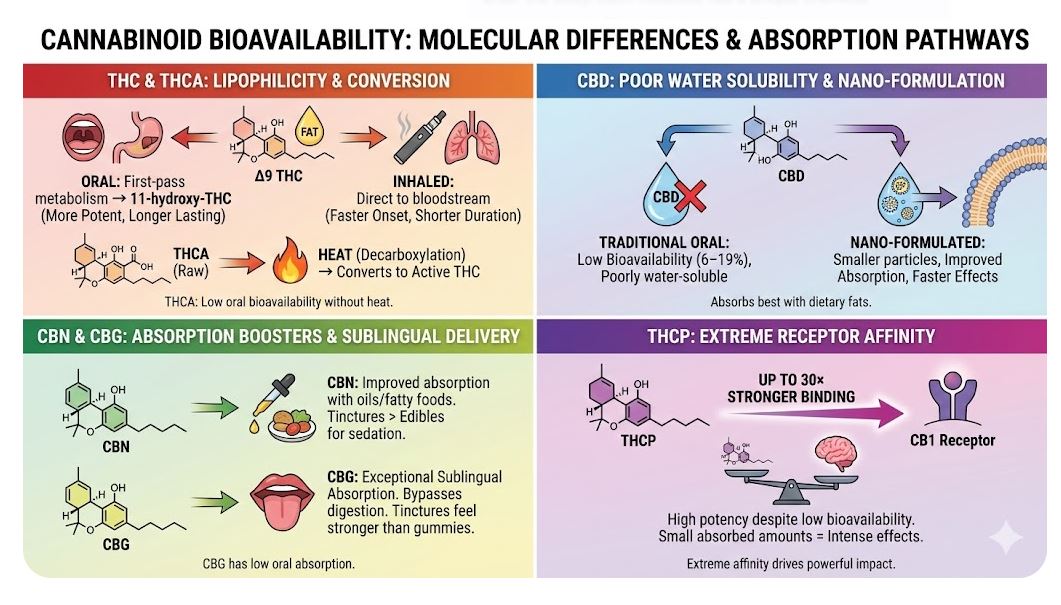
THC is highly lipophilic, meaning it dissolves easily in fats and passes efficiently through cell membranes. When taken orally, it undergoes first-pass metabolism and converts into 11-hydroxy-THC, a metabolite that is significantly more potent and longer-lasting than inhaled THC. This gives oral THC a surprisingly high psychoactive impact despite relatively low bioavailability. Inhaled THC bypasses the liver and enters the bloodstream directly, making it stronger at onset but shorter in duration.
CBD (Cannabidiol)
CBD absorbs best when paired with dietary fats. Traditional oral CBD has low bioavailability (often 6–19%) because it’s poorly water-soluble and heavily processed by the liver. Nano-formulated CBD — broken into tiny particles — improves absorption and creates faster, smoother effects.
CBN (Cannabinol)
CBN behaves similarly to CBD in the digestive tract but tends to show slightly better absorption when taken with oils or fatty foods. Its mild sedative effects often feel more pronounced when delivered through tinctures or softgels rather than edibles.
CBG (Cannabigerol)
CBG has low oral absorption but performs exceptionally well in sublingual formats, where it bypasses digestion and enters the bloodstream directly. This is why CBG tinctures tend to feel stronger and more noticeable than CBG gummies.
THCA (Tetrahydrocannabinolic Acid)
THCA is non-intoxicating unless heated (decarboxylated). Raw THCA has very low oral bioavailability, meaning it provides minimal effect unless inhaled or vaporized to convert into THC.
THCP (Tetrahydrocannabiphorol)
THCP has an extremely high receptor affinity — up to 30× stronger binding at CB1 receptors than THC. Because of this, even small amounts of absorbed THCP produce powerful effects. Its absolute bioavailability doesn’t need to be high for the molecule to feel intense.
How to Increase Cannabis Bioavailability (Practical Tips)
Here are science-backed strategies to improve absorption:
1. Take edibles with healthy fats
Coconut oil, nuts, avocado, olive oil — all boost cannabinoid absorption.
2. Hold tinctures under the tongue for 90 seconds
Most people swallow too quickly; this reduces absorption by 50%+.
3. Choose nano-emulsified products
These improve water solubility and absorption speed.
4. Avoid vaping on a full stomach
Food can reduce lung absorption efficiency.
5. Start with low doses and build slowly
Higher doses don’t always increase absorption — they may overwhelm receptors.
6. Use consistent formats
Bioavailability stabilizes when the body adapts to a consistent routine.
Bioavailability & Safety
Certain extraction or conversion processes affect bioavailability and safety:
-
Poorly purged solvents decrease absorption
-
Conversion cannabinoids (Delta-8, THCP) require clean chromatography
-
Vapes with heavy metals can alter lung permeability
-
Low-quality gummies may degrade in heat or light
Understanding COAs (Certificates of Analysis) is critical — see your Cannabinoid Safety & Lab Testing Guide for more.
Bioavailability & Therapeutic Use Cases
Choosing the right format depends on your goals:
For sleep
-
edibles (long duration)
-
tinctures (smooth onset)
-
transdermals (overnight consistency)
For anxiety
-
tinctures (balanced)
-
vapes (fast relief)
-
low-dose edibles (microdosing)
For pain
-
vapes (fast)
-
capsules (steady)
-
transdermals (targeted, long-lasting)
For creativity or focus
-
microdosed tinctures
-
low-THC vapes
-
nano-beverages
For chronic conditions
-
capsules
-
tinctures
-
transdermal formulations
Future of Cannabis Bioavailability (2025–2030)
Expect major innovation:
1. Next-gen nanotechnology
Ultrafine droplets <100 nm will improve consistency and absorption dramatically.
2. Water-soluble cannabinoids
Already emerging; will redefine edibles, drinks, and syrups.
3. Aerosol-based inhalers
Precise medical dosing with ultra-high bioavailability.
4. Gene-based tolerance personalization
Genetic testing will help tailor THC dosage to your CYP450 profile.
5. Pharmaceutical-grade cannabinoid tablets
High predictability and controlled-release formats.
Conclusion
Bioavailability is the hidden variable that explains why cannabis can feel mild one day, strong another day, or completely different between product types. Once you understand how cannabinoids enter your bloodstream — and how your own biology influences absorption — you gain full control over your cannabis experience.
Whether you’re using cannabis for wellness, medical conditions, creativity, rest, or stress relief, bioavailability helps you choose the right dose, the right product, and the right format. In a world filled with edibles, vapes, tinctures, THCA flower, nano-drinks, capsules, and more, knowledge is the most powerful tool you can carry.