🚛 FREE DISCREET SHIPPING ON ALL ORDERS $49+










The Ultimate Guide to Cannabis Tolerance (2025 Edition)
Introduction If you’ve been consuming cannabis for a while — whether for pain relief, creativity, sleep, anxiety, or simple enjoyment — you’ve probably noticed something change over time. The same vape hit that once sent you floating now barely registers. The gummy that used to relax you now feels mild. The feel-good experience you once relied on becomes harder to

Published on: November 26, 2025

Introduction
If you’ve been consuming cannabis for a while — whether for pain relief, creativity, sleep, anxiety, or simple enjoyment — you’ve probably noticed something change over time. The same vape hit that once sent you floating now barely registers. The gummy that used to relax you now feels mild. The feel-good experience you once relied on becomes harder to reach. This isn’t just your imagination. It’s called cannabis tolerance, and it affects every user eventually.
As cannabis potency has increased and the market has exploded with high-THC gummies, concentrates, vapes, disposables, and THCA flower, tolerance has become a central topic for 2025 consumers. Many wonder:
-
Why doesn’t cannabis hit the same anymore?
-
How long does tolerance take to build?
-
Why are some people naturally more tolerant than others?
-
Can tolerance be reset without quitting for months?
-
Does hemp-derived THC (Delta-8, THCA flower, HHC, THCP) influence tolerance differently?
-
How do frequency, metabolism, and body fat affect tolerance?
The Ultimate Guide to Cannabis Tolerance guide answers all of these questions using clear science, real physiology, and practical insights — not generic cannabis blog filler. Whether you’re a medicinal user trying to regain therapeutic effects or a recreational user wanting to enhance your experience while avoiding overuse, this guide will become your go-to reference.
What Cannabis Tolerance Actually Is (Science Explained Simply)
The concept of tolerance is straightforward: over time, your body becomes less sensitive to a substance, requiring more of it to feel the same effect. But cannabis tolerance is unique because it’s tied directly to the body’s endocannabinoid system (ECS) — a network regulating mood, pain, sleep, appetite, immunity, and memory.
How THC Triggers Tolerance
THC interacts with the CB1 receptor, a type of receptor concentrated in the brain’s:
-
hippocampus (memory)
-
basal ganglia (movement)
-
amygdala (emotion)
-
cerebellum (coordination)
-
cortex (thinking, perception)
When THC binds to CB1 receptors, users feel:
-
relaxation
-
euphoria
-
altered perception
-
appetite increase
-
pain relief
But the body doesn’t like overstimulation. So with repeated THC exposure, it adjusts:
1. CB1 receptor downregulation
The receptors gradually shut down, become less responsive, or move inside the cell where THC can’t reach them.
2. Endocannabinoid suppression
Your body naturally produces endocannabinoids like anandamide. Regular THC use reduces natural production, making you dependent on external cannabinoids for normal function.
3. Altered dopamine signaling
THC influences reward pathways. Frequent use reduces dopamine sensitivity, making cannabis feel less pleasurable.
4. Faster THC metabolite adaptation
The body becomes more efficient at breaking down cannabinoids.
The result: You need more THC to feel the same effect — sometimes much more.
Why Cannabis Tolerance Matters in 2025
Tolerance isn’t just about needing more weed. It impacts:
-
Effectiveness of medicinal cannabis
-
Cost of usage
-
Risk of overconsumption
-
Drug testing timelines
-
Dependence potential
-
Impact of hemp intoxicants like Delta-8, THCA, THCP
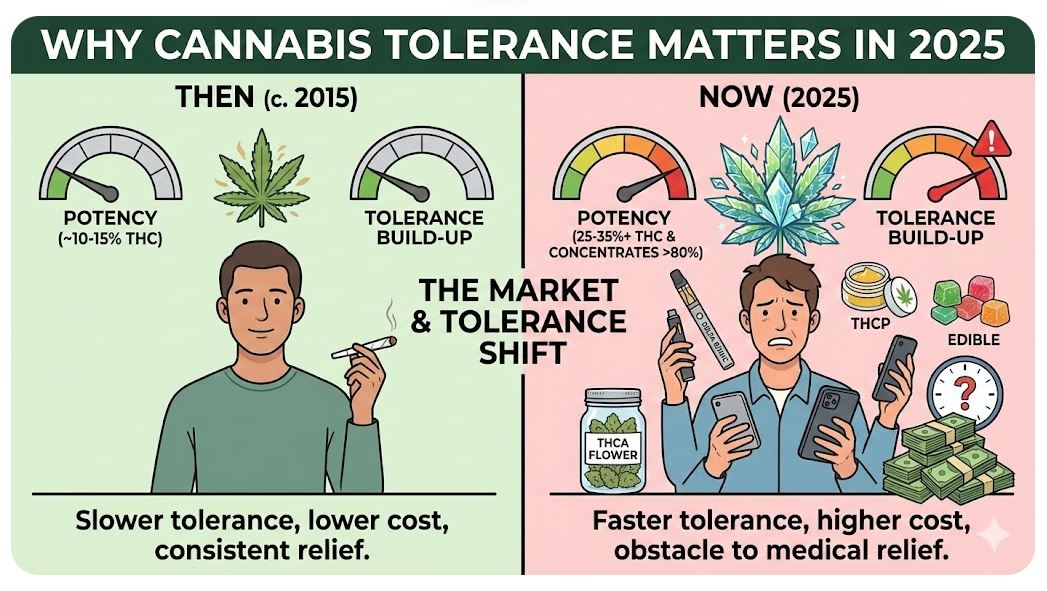
The market changed; tolerance changed with it.
Ten years ago, cannabis contained ~10–15% THC.
Today, THCA flower routinely tests at 25–35% THC, and concentrates exceed 80%.
The hemp sector also transformed tolerance patterns:
-
Delta-8: weaker but consumed more frequently
-
THCA flower: converted to Delta-9 via heat, raising tolerance rapidly
-
THCP: 10–30× stronger than THC — dramatically increases tolerance in small doses
-
HHC: mild but still binds CB1 receptors
Consumers now build tolerance faster than ever — sometimes within days.
Medical patients, especially those using THC for:
-
chronic pain
-
anxiety
-
sleep
-
PTSD
-
muscle spasms
find tolerance a major obstacle to achieving relief.
In 2025, knowing how tolerance works is essential for budget, health, and effectiveness.
Signs & Effects of High Cannabis Tolerance
Tolerance affects people differently, but most experience:
Diminished effects
You feel less:
-
euphoria
-
relaxation
-
body effects
-
pain relief
-
creativity
-
sleepiness
More product needed
You move from:
-
1–2 hits → full joint
-
5–10 mg edible → 25–50 mg
-
1 gummy → 3 gummies
-
one bowl → multiple bowls
-
mild vape → high-potency distillate
Shorter effect duration
Where effects once lasted hours, now they fade quickly.
More frequent consumption
People begin:
-
microdosing throughout the day
-
increasing nighttime doses
-
“chasing the high”
-
turning to stronger forms (dabs, THCP, disposables)
Irritability or restlessness when not using
Not necessarily addiction — often just receptor adaptation.
Reduced medicinal benefit
Patients may find cannabis stops helping with anxiety or pain.
Cross-tolerance with hemp cannabinoids
If you use Delta-9, you will also have reduced sensitivity to:
-
Delta-8
-
HHC
-
THCA flower
-
THCP
-
THC-O
All intoxicating cannabinoids share CB1 pathways.
Why Some People Build Tolerance Faster Than Others
This is one of the most misunderstood aspects of cannabis. Tolerance varies due to genetics, body chemistry, metabolism, and lifestyle.
1. Genetics
Some people have naturally lower CB1 receptor density — requiring more THC from the beginning.
2. Body fat percentage
THC is fat-soluble. High body fat = more storage = prolonged exposure.
3. Frequency of use
Daily users develop tolerance drastically faster than occasional users.
4. Dose size
80% THC vapes cause much faster tolerance buildup than 15% flower or 5 mg edibles.
5. Consumption method
Inhalation hits CB1 receptors instantly → quicker tolerance
Edibles create 11-hydroxy-THC → deeper, more lasting tolerance
Vapes → highest tolerance build per mg
6. Metabolism
Fast metabolisms clear THC quickly → slower tolerance buildup
Slow metabolisms accumulate more THC → faster tolerance buildup
7. Stress & hormones
High cortisol levels alter endocannabinoid signaling.
8. Sleep
Poor sleep reduces ECS recovery, accelerating tolerance.
9. Other cannabinoids consumed
THCP, HHC-P, and high-potency distillates increase tolerance up to 10× faster than flower.
The Science Behind Tolerance Breaks (T-Breaks)
A tolerance break works because the body’s endocannabinoid system begins resetting itself once THC is no longer present. When THC is consumed frequently, the CB1 receptors in the brain become less responsive. This is why regular users often need higher doses to feel the same effects. A tolerance break gives these receptors time to recover, allowing sensitivity to return to normal.
During a T-break, several important biological changes occur. CB1 receptors begin to upregulate, meaning they gradually return to their natural density and responsiveness after being overstimulated by THC. The body also increases production of anandamide, one of its own endocannabinoids, which helps restore balance in mood and motivation pathways.
As THC leaves the system, dopamine receptor sensitivity improves, contributing to better mood stability and motivation. Meanwhile, the liver stops actively processing THC metabolites, allowing stored cannabinoids to be gradually released and eliminated. Because THC binds to fat cells, this process takes time, which is why longer breaks often produce a more noticeable reset.
By the end of a tolerance break, most users experience significantly renewed sensitivity to THC. As CB1 activity normalizes and internal balance is restored, smaller doses become effective again, often leading to a smoother, more enjoyable experience.
How long does a real reset take?
This depends on usage:
| Frequency | Recommended T-Break |
|---|---|
| Occasional | 48–72 hours |
| Weekly | 1–2 weeks |
| Daily | 2–4+ weeks |
| Multiple times daily | 4–6+ weeks |
| Heavy dab/vape users | 6–8+ weeks |
| THCP or concentrate users | 8+ weeks |
But there are alternatives — you don’t always need a full break.
Advanced Tolerance Reset Methods (Beyond T-Breaks)
Not everyone wants to quit cannabis for weeks. Here are real, science-backed strategies that help reset sensitivity without fully stopping.
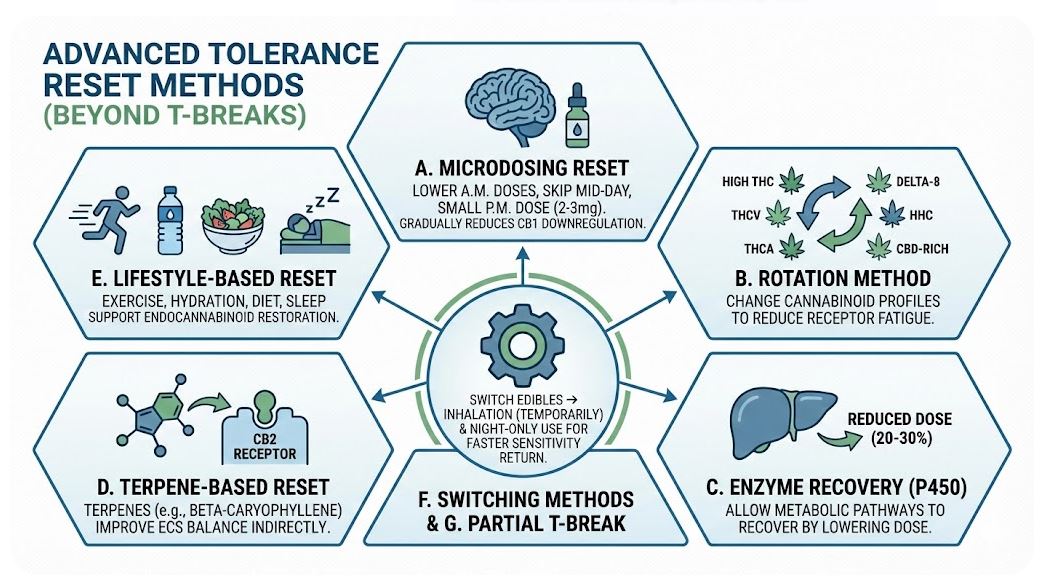
A. Microdosing Reset
Lower A.M. doses
Skip mid-day sessions
Small P.M. dose (2–3 mg equivalent)
Gradually reduces CB1 downregulation.
B. Rotation Method
Rotate:
-
high THC → THCV-dominant
-
Delta-9 → Delta-8 or HHC
-
THCA flower → CBD-rich flower
Changing cannabinoid profiles reduces receptor fatigue.
C. Enzyme Recovery (Cytochrome P450)
High-frequency users overwhelm metabolic pathways. Reducing dose by 20–30% allows enzymes to recover.
D. Terpene-Based Reset
Terpenes like beta-caryophyllene interact with CB2 receptors, indirectly improving ECS balance.
E. Lifestyle-Based Reset
-
intermittent fasting
-
aerobic exercise
-
hydration
-
minimizing sugar
-
improving sleep quality
These support endocannabinoid restoration.
F. Switching Edibles → Inhalation (Temporarily)
Edibles create stronger 11-hydroxy-THC tolerance. Switching to vaping or low-THC flower for a few weeks helps reset edible tolerance faster.
G. The Partial T-Break
Use only at night → sensitivity returns in 5–10 days.
Cannabis Tolerance vs. Cannabinoid Type (Very Important)
Different cannabinoids influence tolerance differently:
Delta-9 THC
Strong CB1 binder
Fast tolerance buildup
Most cross-tolerance influence
THCA Flower
When heated → Δ9 THC
Tolerance identical to cannabis flower
Delta-8 THC
50–70% potency
Milder but causes tolerance faster because users consume more frequently
HHC
Slightly less potent
Still increases CB1 downregulation
Often used repeatedly → faster tolerance
THCP
10–30× stronger than THC
Extreme tolerance buildup
Small doses (~1 mg) can increase tolerance for weeks
THC-O / Synthetic Cannabinoids
Much stronger receptor binding
Tolerance increases rapidly and unpredictably
CBD
Does NOT create tolerance
May reverse THC tolerance slightly
CBD promotes receptor upregulation in some studies
Understanding the cannabinoid you use is essential to understanding your tolerance trajectory.
Cannabis Tolerance vs. Body Chemistry, Metabolism & Physiology
Tolerance isn’t just about how much you use — it’s also about how your body handles cannabinoids.
High Body Fat = Higher Tolerance
THC stored in fat leaks back into the bloodstream, continuously activating CB1 receptors.
Slower Metabolism = Higher Tolerance
Slower metabolizers maintain higher cannabinoid levels for longer.
Frequent Edible Consumption
Edibles trigger 11-hydroxy-THC buildup → deeper CB1 downregulation.
Nighttime Consumption
Lower metabolic activity at night = slower THC clearance = increased tolerance.
Hydration
Dehydrated users clear metabolites slower → prolonged receptor exposure.
Aerobic Activity
Exercise a few days before a session reduces stored cannabinoid load, helping tolerance reset gradually.
Tolerance & Drug Testing: How They Interact
Tolerance and drug testing are closely connected because the way your body handles THC changes with frequent use. When someone has a high THC tolerance, it usually means they’ve been consuming cannabinoids regularly enough for the body to store significant amounts of metabolites in fat cells. Since THC is fat-soluble, these metabolites are released slowly over time, which extends the period during which they can be detected on drug tests.

As tolerance increases, metabolite clearance becomes slower. Daily or heavy users often have a longer detection window simply because their bodies have accumulated more THC over time. For many daily consumers, it can take 30–45 days to fully clear THC from the system. For individuals with a higher body fat percentage, the window can extend to 60 days or more, especially if consumption includes potent edibles or stronger cannabinoids such as THCP. Because these compounds bind more tightly to fat, they take longer to metabolize and eliminate.
By contrast, individuals with lower tolerance typically clear THC faster because their bodies store fewer metabolites. This means occasional users may test negative within days rather than weeks. In short, tolerance directly influences detection times: the higher the tolerance, the longer THC remains detectable.
Long-Term Effects of High Tolerance
Most effects are reversible, but long-term high tolerance can lead to:
1. Diminished ECS sensitivity
Your body produces fewer natural endocannabinoids.
2. Increased cost
You may spend 2–5× more on cannabis.
3. Lower therapeutic benefit
Chronic pain, anxiety, or insomnia patients may lose efficacy.
4. Psychological dependence risk
Not chemical addiction — but habit reinforcement.
5. Decreased motivation & enjoyment
Some users feel blunted or foggy with long-term high tolerance.
6. Reduced dopamine sensitivity
Less enjoyment from both cannabis and everyday experiences.
How to Manage Cannabis Tolerance Long-Term
Based on science and clinical insights, long-term management strategies include:
A. Planned Consumption Schedules
Avoid using cannabis at identical times daily — the body adapts.
B. Avoid Wake-and-Bake
THC hits hardest on an empty CB1 system. Morning use creates rapid tolerance buildup.
C. Embrace Microdosing
3–5 mg THC sessions maintain benefits with minimal tolerance.
D. Incorporate CBD
CBD preserves ECS sensitivity and counters excessive CB1 suppression.
E. Rest Days
Even one day per week significantly slows tolerance buildup.
F. Avoid Ultra-Potent Products
90% distillate, 30% THCA flower, and THCP cause the fastest tolerance build.
G. Maintain a Strong Lifestyle Foundation
Healthy sleep, exercise, hydration, and diet support ECS restoration.
Frequently Asked Questions (Expert Answers)
Does taking a break for two days lower tolerance?
Yes. For light or occasional users, even a 48-hour pause can noticeably restore CB1 receptor sensitivity.
Do edibles increase tolerance more quickly?
Yes. Edibles convert THC into 11-hydroxy-THC, which is stronger and creates deeper, longer-lasting receptor adaptations.
Does vaping increase tolerance more than smoking?
Usually yes. Vaping delivers higher potency and faster absorption, which accelerates tolerance buildup compared to smoking.
Does THCP increase tolerance dramatically?
Yes. THCP binds far more strongly to CB1 receptors, meaning even microdoses can rapidly elevate tolerance levels.
Can CBD lower THC tolerance?
Possibly. Early research indicates CBD may support CB1 receptor recovery and help rebalance the endocannabinoid system.
Conclusion
Cannabis tolerance is a natural, physiological process driven by CB1 receptor behavior, metabolic factors, lifestyle patterns, and cannabinoid potency. As cannabis and hemp products grow stronger and more diverse — from THCA flower to Delta-8 disposables to ultra-potent THCP vapes — tolerance management has become essential.
Understanding how tolerance develops, how your body chemistry affects it, and how to manage it long-term empowers you to consume more intentionally, effectively, and safely. Whether you’re seeking medicinal results, better highs, or a healthier relationship with cannabis, this guide gives you the science and strategies to take control of your tolerance instead of letting it control you.