🚛 FREE DISCREET SHIPPING ON ALL ORDERS $49+










The Ultimate Guide to Drug Testing & Cannabinoids (2025 Edition)
Introduction Drug testing has become a deeply complex topic in the cannabinoid era. What used to be a straightforward question — “Will weed show up on a drug test?” — has turned into a maze of confusing cannabinoid names, legal loopholes, hemp products, and misleading marketing claims. Consumers today face Delta-8, Delta-9, THCA, HHC, THCP, CBN, CBD, full-spectrum oils, broad-spectrum

Published on: December 1, 2025
Introduction
Drug testing has become a deeply complex topic in the cannabinoid era. What used to be a straightforward question — “Will weed show up on a drug test?” — has turned into a maze of confusing cannabinoid names, legal loopholes, hemp products, and misleading marketing claims. Consumers today face Delta-8, Delta-9, THCA, HHC, THCP, CBN, CBD, full-spectrum oils, broad-spectrum tinctures, edibles, vapes, topicals, and more. Each one metabolizes differently. Each interacts with your endocannabinoid system in a unique way. And each has its own relationship with drug testing.
The problem is that most online explanations oversimplify the issue. Some creators falsely claim Delta-8 “won’t show up.” Others claim THCA is “safe because it’s not THC.” Meanwhile, millions of consumers — workers, students, athletes, and medical patients — face real consequences for failing drug tests they didn’t even know they could fail.
The Ultimate Guide to Drug Testing & Cannabinoids (2025 Edition) clears everything up once and for all. It explains the science of cannabinoid metabolism, why tests detect certain compounds, how long cannabinoids stay in your system, how different product types affect detection windows, and what you can realistically do to minimize risk.
If you’ve ever wondered how drug tests identify THC, whether hemp products are safe, or how long cannabinoids remain detectable, this is the most complete and up-to-date resource you’ll find.
How Drug Testing Works (Science Explained Simply)
Most drug tests don’t look for drugs themselves. They look for metabolites, which are chemical byproducts your body creates after breaking down a substance.
THC Metabolism
When you consume any psychoactive cannabinoid — Delta-9, Delta-8, THCA (after heating), HHC, THCP, or others — your liver converts it primarily into:
-
11-hydroxy-THC
-
THC-COOH (the main detectable metabolite)
THC-COOH is what urine tests measure. Your body stores this metabolite in fat cells, releasing it slowly over time. That’s why THC can remain detectable long after the high is gone.
Why Drug Tests Can’t Tell Cannabinoids Apart
Most standard tests do not compare different THC analogs. They test for THC-COOH, which forms after consuming:
-
Delta-9 THC
-
THCA (when heated or partially metabolized)
-
Delta-8 THC
-
HHC
-
THCP
-
THC-O (now banned federally)
To the test, these all look the same — because they all produce similar metabolites.
Types of Drug Tests
-
Urine Tests (Most Common)
Detect THC-COOH. Detection window: days to weeks. -
Blood Tests
Detect active THC, not metabolites. Short window: hours to 1–2 days. -
Saliva Tests
Detect active THC in the mouth. Window: hours to 1–2 days. -
Hair Tests
Detect long-term use. Window: up to 90 days.
Why Drug Testing Matters More Than Ever (2025 Landscape)
Drug testing has expanded far beyond government jobs and corporate HR departments. Today:
-
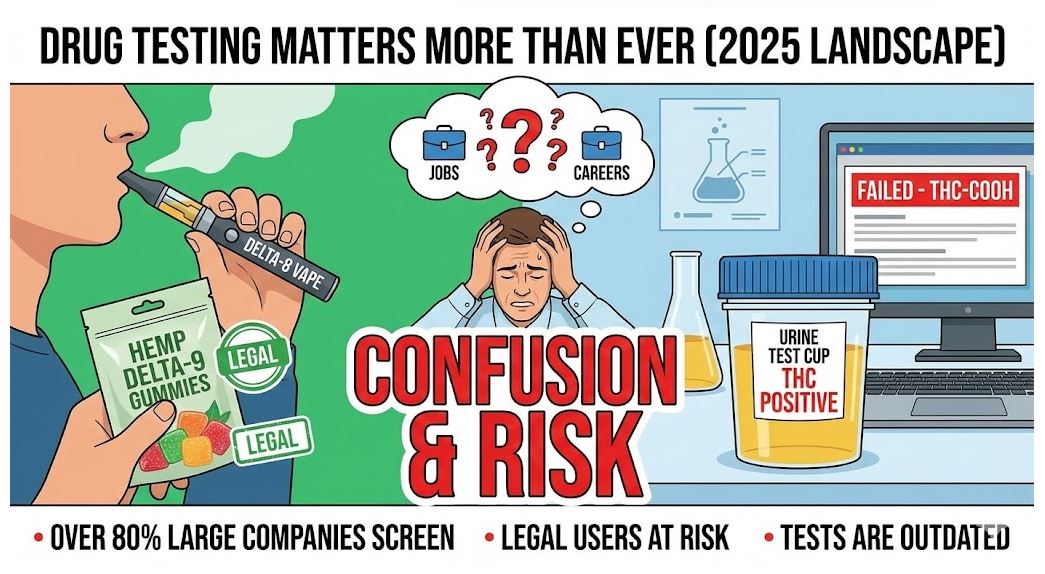
Over 80% of large companies conduct some form of drug screening.
-
Many state-legal cannabis users can still lose jobs due to testing.
-
Hemp consumers are often unaware that “legal” does not mean “won’t show up.”
-
Pre-employment testing remains common in transportation, healthcare, security, logistics, and manufacturing.
The hemp boom has also created widespread confusion. With so many “legal” intoxicating cannabinoids available online — THCA flower, Delta-8 vapes, hemp Delta-9 gummies — people assume drug tests have adapted. They have not. Most tests were designed decades ago and still focus on THC-COOH, not legality or cannabinoid type.
In 2025, drug testing has become a major pain point, especially as alternative cannabinoids gain popularity. People want the wellness and recreational benefits of cannabinoids — but they also want to protect their careers. This guide helps you understand exactly what’s at risk.
How Long Cannabinoids Stay in Your System (Full Breakdown)
This section explains detection windows for each major cannabinoid and product type.
Table: Approximate Detection Windows (Urine Testing)
| Cannabinoid/Product | Occasional Use | Moderate Use | Daily Use | Notes |
|---|---|---|---|---|
| Delta-9 THC | 2–5 days | 7–15 days | 30–45+ days | Longest retention of all cannabinoids. |
| Delta-8 THC | 2–5 days | 7–10 days | 20–30 days | Converts into very similar metabolites. |
| THCA (smoked/vaped) | 2–5 days | 7–15 days | 30–45+ days | Converts directly into Delta-9 metabolites. |
| HHC | 3–7 days | 10–20 days | 30+ days | Metabolites closely resemble THC. |
| THCP | 7–14 days | 14–30 days | 45+ days | Extreme potency means stronger metabolite storage. |
| CBD (full-spectrum) | 0–3 days | 3–5 days | 5–7 days | Only risky if trace THC present. |
| CBD (broad-spectrum/isolate) | 0 days | 0 days | 0 days | No THC present → no detection. |
Important note: These numbers vary widely based on metabolism, hydration, frequency, and body fat.
Effects of Different Cannabinoids on Drug Testing
Each cannabinoid interacts uniquely with drug testing.
THCA and THCA Flower
This is the biggest surprise for most people. THCA is non-intoxicating in its raw form — but the moment it’s heated, it converts into Delta-9 THC. That means:
➡️ THCA flower = THC flower (in the eyes of a drug test)
Even small amounts will produce THC metabolites similar to cannabis.
Delta-8 THC
Delta-8 converts to nearly identical metabolites as Delta-9. Urine tests cannot distinguish between them.
➡️ Delta-8 WILL trigger a positive test.
HHC
Although HHC has a slightly different structure, the body metabolizes it into compounds that cross-react with typical THC immunoassays.
➡️ HHC CAN trigger positive results.
THCP
THCP binds 10–30× more strongly to cannabinoid receptors and also produces THC-like metabolites.
➡️ THCP is extremely likely to trigger a positive test — often at lower doses.
CBD
Pure CBD (isolate or broad-spectrum) should not cause a positive test. However:
-
many CBD products contain trace THC
-
labels often underestimate THC percentages
-
full-spectrum CBD almost always contains detectable THC
➡️ Full-spectrum CBD may cause a positive result with heavy or consistent use.
CBN
Interestingly, older CBN research suggested possible false positives. But modern tests rarely confuse CBN with THC metabolites.
➡️ CBN is low risk but not zero risk.
Why Edibles, Vapes, and Flower Have Different Detection Windows
Even with the same cannabinoid content, different product types metabolize differently.
Flower (THCA or Delta-9)
Absorbs fast → metabolizes quickly → leaves body slower due to fat storage.
Vapes (all cannabinoids)
High bioavailability → sudden spike in THC levels → deeper metabolite storage.
Edibles (THC/THCA/D8/HHC)
Liver converts THC into 11-hydroxy-THC, a stronger metabolite.
This metabolite is:
-
more potent
-
longer-lasting
-
more easily stored in fat
-
harder to eliminate
This is why edible users often fail drug tests for longer than smokers.
Tinctures
Sublingual absorption reduces metabolite load compared to edibles, but still produces THC-COOH if the product contains THC or THCA.
What Drug Tests Actually Detect — and Why
Most people think drug tests are searching for THC itself. Not true.
Urine tests detect:
-
THC-COOH, a metabolite that remains long after the high fades
-
Stored in fat and released slowly
Blood tests detect:
-
active Delta-9 THC
-
short detection window — usually <24 hours
Saliva tests detect:
-
active THC residue
-
lasts 6–24 hours
Hair tests detect:
-
long-term metabolite patterns
-
up to 90 days
Critical Insight: Cannabinoid legality does NOT matter to drug tests.
Hemp-derived THC is chemically identical to cannabis-derived THC. Metabolites are indistinguishable.
Can You “Beat” a Drug Test? (Realistic Explanation)
This is where misinformation spreads the fastest.
Hydration doesn’t eliminate THC.
It only dilutes metabolite concentration temporarily.
Detox kits do not remove THC from fat cells.
Most detox drinks simply:
-
dilute urine
-
add vitamins to change urine color
-
obscure creatinine levels
-
hope the test doesn’t flag “dilute sample”
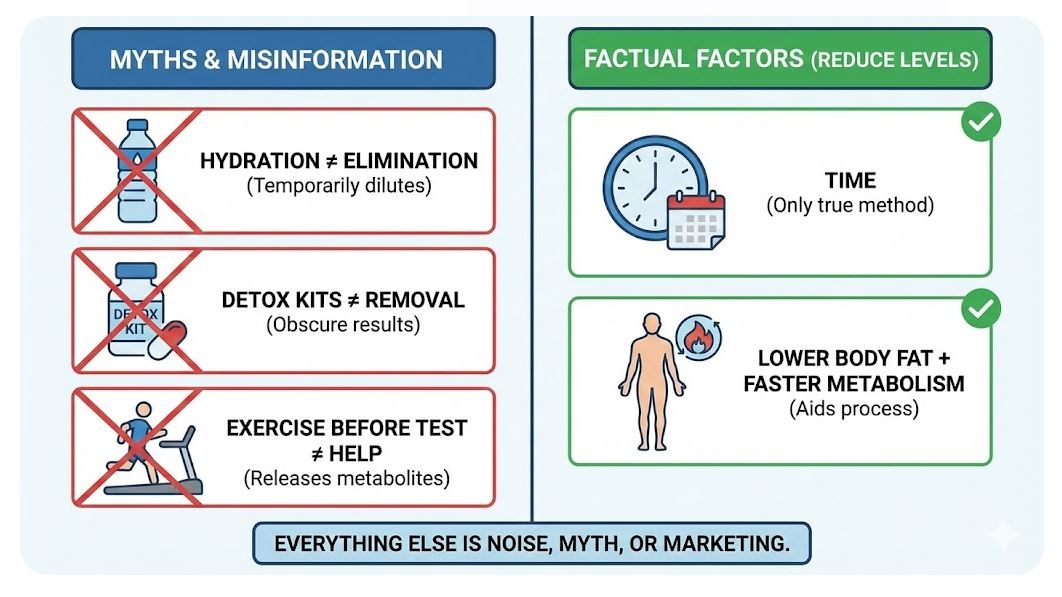
Exercise right before a test can make results worse.
Burning fat releases THC metabolites into the bloodstream.
Only two things truly reduce THC levels:
-
Time
-
Lower body fat + faster metabolism
Everything else is noise, myth, or marketing.
State-by-State Drug Testing Laws (2025 Landscape)
Many states now protect legal cannabis users — but hemp users do NOT always receive the same protections.
States That Protect Some Workers from Positive THC Tests
Examples include:
-
Nevada (first state to ban pre-employment THC tests for most jobs)
-
California (strong protections for off-duty cannabis use)
-
New York
-
New Jersey
-
Connecticut
States That Test Aggressively
-
Texas
-
Florida
-
Georgia
-
South Carolina
-
Indiana
-
Tennessee
These states often include THC, Delta-8, and even synthetic cannabinoid screening.
Why This Matters
Even if hemp products are legal in your state, employers may still enforce federal-style zero-tolerance policies.
The Role of Tolerance, Metabolism, and Body Chemistry
Drug test outcomes vary dramatically from person to person because cannabinoid metabolism is deeply influenced by individual physiology. Once THC and other intoxicating cannabinoids enter the body, the way they are stored, processed, and released depends far more on your biology than on the product itself. This is why two people can consume the same amount and have completely different detection windows.
Several factors can extend how long cannabinoids remain detectable. Higher body fat increases storage of THC metabolites, since THC-COOH binds to fat cells and releases slowly over time. Daily or heavy use further saturates those cells, making detox significantly longer. Slower metabolism, dehydration, frequent edible consumption, and nighttime dosing — when the body’s metabolic rate naturally drops — can all lengthen the detection window.
On the other hand, certain factors shorten the time it takes to test clean. Individuals with low body fat typically eliminate metabolites more quickly. Faster metabolism speeds detox naturally, while infrequent use allows the body to clear THC before it fully accumulates. Aerobic exercise performed days before the test (not right before) and consistent hydration also support metabolite turnover.
Because these variables differ widely among individuals, there is no universal detox timeline — only personalized ranges.
How Long It Takes to Get Clean (Realistic Timelines)
Clearing cannabinoids from your system isn’t a one-size-fits-all process. While many people hope for a simple, universal timeline, detox speed depends on frequency of use, body composition, metabolism, product type, and the specific cannabinoid consumed. Still, there are realistic ranges that apply to most users, and understanding them can help you plan responsibly if drug testing is a concern.
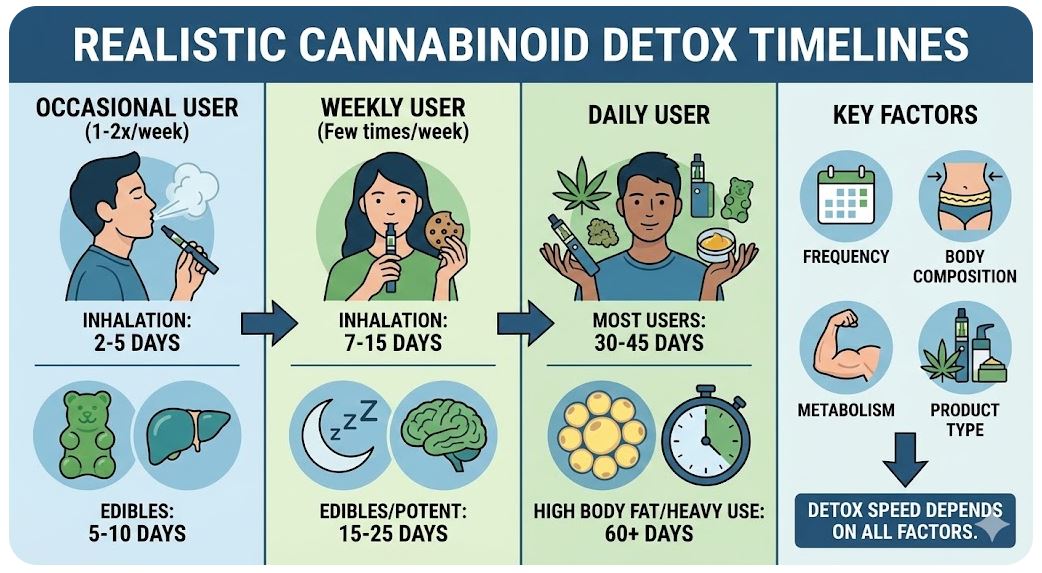
Occasional users—people who consume cannabinoids once every one to two weeks—typically test clean the fastest. For most inhaled cannabinoids, including Delta-9, Delta-8, HHC, THCA (after heating), and mild THCP exposure, metabolites clear in about 2–5 days. However, edibles take longer because the liver converts THC into 11-hydroxy-THC, which is more potent and stored more efficiently in fat cells. For edible users, a window of 5–10 days is more realistic.
Weekly users—those who consume a few times per week—accumulate more metabolites over time, meaning detox takes longer. Most moderate users need 7–15 days to test clean after inhalation products. When it comes to edibles or potent cannabinoids like THCP, the window increases to 15–25 days, especially if products are high-dose or consumed before bed, when metabolism slows.
Daily users face the longest detox periods because THC metabolites accumulate deeply in fat tissue and release into the bloodstream slowly. For those who smoke or vape strong cannabinoids every day, it often takes 30–45 days to consistently test clean. For individuals with higher body fat, slower metabolism, or heavy edible consumption, the detox window can stretch to 60 days or more.
How to Reduce Risk If You Use Cannabinoids
This guide is designed to inform — not encourage misuse of drug tests.
But if you want to reduce risk responsibly, here are realistic strategies:
1. Switch to Broad-Spectrum or CBD-Isolate Products
Zero THC → zero metabolite formation.
2. Avoid THCA Flower Entirely
It is chemically no different from THC flower when heated.
3. Avoid High-Potency Edibles
They create more lasting metabolites.
4. Give Yourself Time
The only guaranteed solution.
5. If Testing Is Certain, Stop All THC Analogues
This includes:
-
Delta-8
-
Delta-9
-
THCA
-
HHC
-
THCP
-
THC-O (now illegal anyhow)
Even a few puffs of THCA or THCP can extend detection windows dramatically.
Myths That Need to Be Debunked
Myth: “Hemp THC won’t show up.”
It will — the test cannot distinguish source.
Myth: “Delta-8 is safe for drug tests.”
False — Delta-8 produces THC-COOH.
Myth: “Detox drinks flush THC out.”
They don’t. They only dilute.
Myth: “Topicals will cause a positive.”
Mostly false — topicals don’t reach bloodstream.
Myth: “THCA is safe because it’s not psychoactive.”
False — heated THCA becomes THC.
Conclusion
Drug testing in the cannabinoid era is confusing because the laws have changed, but the testing technology has not. Employers still use metabolite-based screening, which cannot distinguish between cannabis, hemp-derived THC, Delta-8, THCA, or any other psychoactive cannabinoid. If it becomes THC-COOH in the body, it will show up.
Understanding how cannabinoids are metabolized, how long they remain detectable, and how product type affects your system is essential for protecting your job, license, education, or athletic eligibility. While no detox product or trick can erase THC metabolites overnight, informed decisions, realistic timelines, and smart product choices can significantly reduce risk.
Whether you’re using cannabinoids for wellness, recreation, or therapeutic reasons, this guide empowers you with the science — not the myths — behind drug testing in 2025. With the right knowledge, you can navigate the cannabinoid landscape confidently, safely, and with full awareness of how each product may impact testing outcomes.