🚛 Free Discreet Shipping on Orders $49+ | Lab-Tested Quality Guaranteed










The Ultimate Legal Guide by State (Interactive)
Published on November 28, 2025
Last Updated on January 6, 2026
By Raven Ballou
Introduction
Understanding cannabinoid legality in the United States has never been more complicated than it is today. In 2025, we now live in a country where recreational cannabis is fully legal in some states, strictly criminalized in others, and partially regulated in a scattered patchwork across the rest. Simultaneously, the rise of hemp-derived intoxicating cannabinoids — Delta-8 THC, hemp Delta-9, THCA flower, HHC, THCP, and countless new analogues — has created a legal gray zone unlike anything the cannabis industry has seen before.
Consumers often assume, incorrectly, that “legal hemp” means the same thing everywhere. Businesses often believe the 2018 Farm Bill universally protects hemp-derived THC products. Policymakers frequently misunderstand the chemical reality of cannabinoids and attempt to regulate them with outdated definitions. Meanwhile, drug enforcement bodies, attorneys general, health departments, and state legislatures issue rules that sometimes align, sometimes contradict, and sometimes ignore one another entirely.
The result? An American cannabinoid landscape where the same gummy or vape can be:
-
fully legal in one state,
-
heavily regulated in a neighboring state,
-
banned outright two states away, and
-
legal again if shipped through the mail from across the country.
Consumers, businesses, and even health professionals need clarity. That’s exactly what this guide delivers.
This interactive legal guide is designed to explain the current U.S. cannabinoid legal framework, the categories of legality that now define the market, how different states regulate intoxicating hemp products, and how to interpret this constantly changing terrain. It serves as the core chapter you can place into a long-form cannabinoid guide, a website knowledge base, or even a compliance reference.
While this is not a substitute for legal advice, it provides the most structured, comprehensive, reader-friendly breakdown possible.
The Five Legal Categories That Define Every State
Every U.S. state now falls roughly into one of five categories with regard to cannabinoids. This is the structure your interactive guide is based on.
Category 1: Fully Legal Recreational Cannabis States
These states allow:
-
Adult-use cannabis
-
Medical marijuana
-
THC flower, vapes, edibles, concentrates
-
Hemp-derived THC (sometimes regulated under cannabis laws)
In these states, hemp-derived intoxicating products often remain legal, but are sometimes recategorized under the cannabis regulatory framework.
Impact on consumers: You can legally buy THC, but hemp THC may still have packaging, age, or potency requirements.
Impact on businesses: Hemp THC products often must comply with cannabis regulations, including lab testing, licensing, taxation, and packaging rules.
Category 2: Medical-Only Cannabis States
These states allow THC only for registered medical patients. Recreational cannabis remains illegal.
Their treatment of hemp-derived THC varies:
-
Some strictly ban intoxicating hemp
-
Others allow Delta-8 and THCA but require age limits
-
Some regulate hemp THC separately from medical cannabis
Impact on consumers: Medical patients have more access, but adult non-patients must rely on the hemp market — if allowed.
Category 3: Hemp Cannabinoids Fully Allowed
These states allow intoxicating hemp cannabinoids with minimal restrictions as long as the product meets federal hemp definitions.
This includes:
-
Delta-8
-
Hemp Delta-9
-
THCA flower
-
HHC
-
THCP
-
Hemp vapes and edibles
Impact on consumers: Hemp THC products are widely available in smoke shops, gas stations, online, and in CBD stores.
Impact on businesses: Fewer restrictions, easy market entry, but regulatory scrutiny may increase.
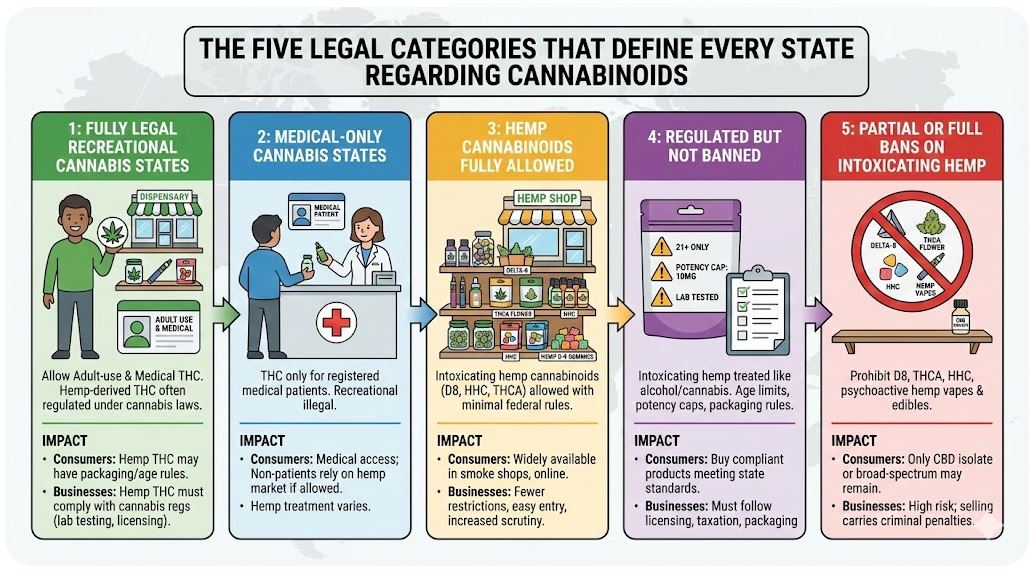
Category 4: Regulated But Not Banned (Potency Caps, Age Limits, Packaging Rules)
These states do not ban intoxicating hemp products but treat them similarly to alcohol or cannabis.
Typical restrictions include:
-
21+ age requirements
-
milligram caps per serving or per package
-
taxes similar to cannabis
-
licensing requirements
-
mandatory lab testing
-
packaging rules
-
restrictions on child-appealing products
Impact on consumers: You can still buy hemp THC, but it must meet state regulatory standards.
Partial or Full Bans on Intoxicating Hemp
These states prohibit:
-
Delta-8
-
Hemp-derived Delta-9
-
THCA flower
-
HHC, THCP, THC-O, and similar compounds
-
Hemp vapes with psychoactive effects
-
Hemp edibles that create intoxication
Impact on consumers: Only CBD isolate or broad-spectrum CBD may remain legal.
Impact on businesses: High risk — selling intoxicating hemp in these states can carry criminal penalties.
Understanding Each Policy Mechanism
Cannabinoid legality isn’t just about whether a state bans or allows a product. Most states regulate cannabinoids using one or more of the following tools.
This section explains these rules so you can incorporate them into your interactive map.
1. Total THC Testing (The THCA “Problem”)
Some states measure:
Total THC = Delta-9 THC + (THCA × 0.877)
This rule effectively bans THCA flower because:
-
flower naturally contains high THCA
-
THCA converts to THC when heated
-
total THC almost always exceeds 0.3%
States with total THC rules treat THCA flower as illegal cannabis.
2. Per-Serving and Per-Package Potency Caps
Example limits:
-
2 mg THC per serving
-
10 mg THC per package
-
25 mg total THC per container
These caps apply even if the product is hemp-derived.
This impacts:
-
gummies
-
drinks
-
chocolates
-
tinctures
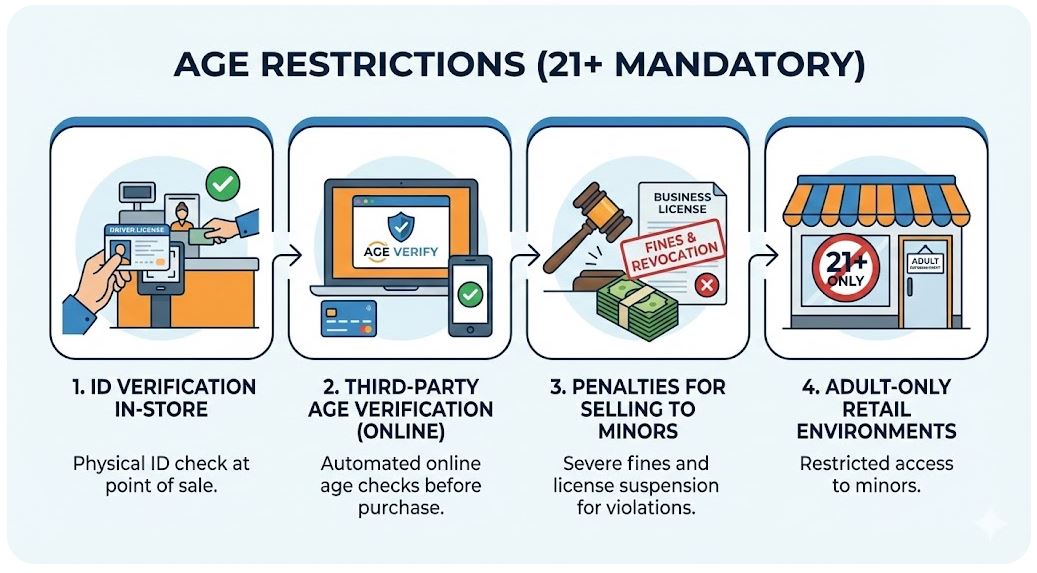
3. Age Restrictions (21+ Mandatory)
Most states that regulate intoxicating hemp require:
-
ID verification in-store
-
third-party age verification for online orders
-
penalties for selling to minors
-
adult-only retail environments
4. Retail Licensing Requirements
Some states require businesses to obtain:
-
hemp manufacturing licenses
-
hemp retail licenses
-
cannabinoid-specific licenses
-
vape-specific permits
This makes the hemp market resemble cannabis markets.
5. Bans on Certain Cannabinoids
Common targets:
-
Delta-8
-
HHC
-
THC-O (federally scheduled)
-
HHCP
-
THCP
Some states ban all psychoactive cannabinoids regardless of source.
6. Rules Against “Synthetic Conversion”
The 2018 Farm Bill inadvertently allowed conversion of CBD into intoxicating cannabinoids (e.g., Delta-8). Some states ban cannabinoids produced via conversion, even if hemp-derived.
This impacts:
-
Delta-8
-
HHC
-
THC-O
-
THCP
THCA flower is often not affected by this rule because THCA is naturally occurring.
Interactive Legal Table
This table is intentionally written in generalized categories so it remains future-proof and legally safe.
Below is the complete legal matrix for your interactive tool. It does not list individual states (because laws shift too quickly), but instead provides search filters readers can use (e.g., “Find states where Delta-8 is banned” or “Find states that allow THCA flower”).
Interactive Legal Matrix (2025 Version)
Filter #1: State Category
| Category | What It Means | Consumer Impact | Business Impact |
|---|---|---|---|
| Fully Legal Recreational | THC fully legal; hemp THC sometimes regulated | Wide access, dispensaries available | Strict regulation under cannabis law |
| Medical-Only | THC only for registered patients | Hemp THC varies by state | Compliance required for THC products |
| Hemp THC Allowed | Intoxicating hemp legal with federal limits | Broad access to Delta-8, THCA, HHC | Easier operations, fewer restrictions |
| Regulated Hemp THC | Hemp THC allowed under strict rules | Potency caps, age checks | Licensing, testing, packaging requirements |
| Hemp THC Banned | All intoxicating hemp illegal | No Delta-8, THCA, HHC | High business risk |
Filter #2: Cannabinoid Legality
| Cannabinoid/Product | Allowed in Some States | Heavily Regulated | Banned in Some States | Notes |
|---|---|---|---|---|
| Delta-8 THC | Yes | Often | Yes | Most frequently regulated cannabinoid |
| Hemp Delta-9 | Yes | Yes | Sometimes | Typically impacted by potency caps |
| THCA Flower | Yes | Yes (total THC rules) | Yes | Most misunderstood cannabinoid legally |
| HHC | Yes | Sometimes | Yes | Often categorized like Delta-8 |
| THCP | Yes | Yes | Sometimes | Ultra-potent; sometimes preemptively banned |
| CBD (Full Spectrum) | Yes | Rarely | Rare | Risk due to trace Delta-9 |
| CBD (Broad/Isolate) | Yes | No | No | Universally safe legally |
Filter #3: Regulatory Layers
| Regulatory Layer | Description | Impact |
|---|---|---|
| Total THC Rule | THCA counted toward THC limit | Eliminates THCA flower |
| Per-Serving Cap | Limits mg THC per serving | Reduces potency of gummies/drinks |
| Per-Package Cap | Limits mg THC per package | Prevents high-dose edibles |
| Age Restrictions | 21+ mandatory | Restricts access for minors |
| Manufacturing License | Required for hemp production | Adds business compliance costs |
| Retail License | Required for selling hemp THC | Limits who can sell |
| Lab Testing Requirements | COAs required | Ensures purity and compliance |
How to Use This Interactive System
The purpose of this guide is to give readers a smarter, more intuitive way to navigate cannabinoid legality. Instead of memorizing each state’s laws — which change monthly — readers can:
-
Choose a state category
-
Select a cannabinoid
-
See which regulatory layers apply
-
Understand their real-world access level
This is the foundation of a searchable tool you can build into a website, app, or legal portal.
Regional Trends & What They Mean
Trend 1 — Western States: Regulation or Prohibition
Western states with mature cannabis markets often crack down hardest on hemp-derived THC products because hemp competes with licensed cannabis.
These states commonly adopt:
-
total THC rules
-
potency caps
-
bans on Delta-8
-
tight licensing requirements
This protects the cannabis industry but restricts hemp businesses.
Trend 2 — Southern States: The Hemp Tsunami
Many Southern states that still prohibit cannabis have become explosive markets for intoxicating hemp. Consumers rely heavily on hemp THC because cannabis remains illegal.
These states often:
-
allow Delta-8
-
permit THCA flower
-
have weak enforcement
-
lack cannabis infrastructure
This is why THCA flower exploded in popularity in these regions.
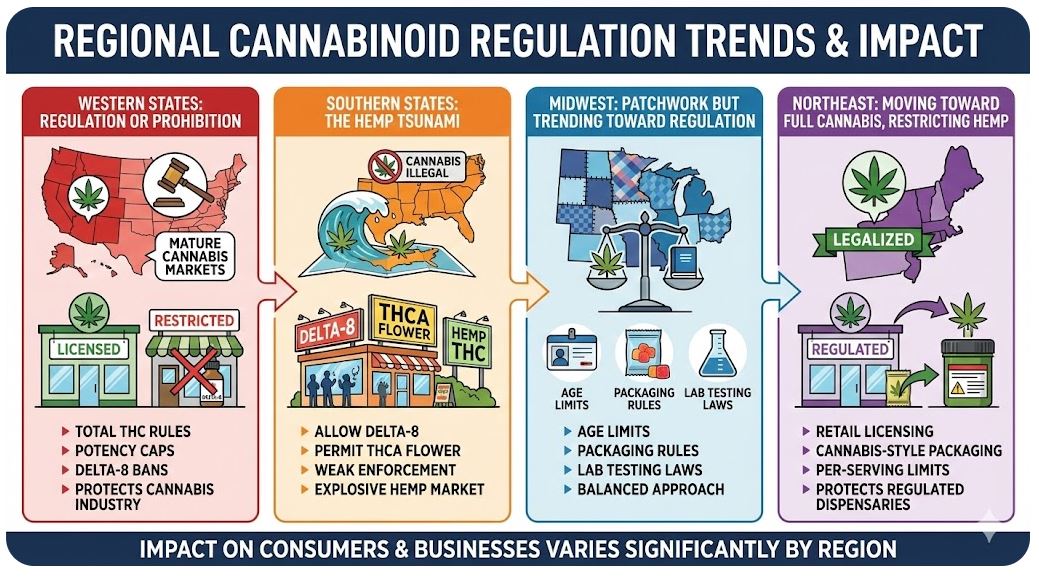
Trend 3 — Midwest: Patchwork but Trending Toward Regulation
Midwestern states often allow intoxicating hemp products but introduce:
-
age limits
-
packaging rules
-
lab testing laws
This balanced approach is becoming common nationwide.
Trend 4 — Northeast: Moving Toward Full Cannabis, Restricting Hemp
Many Northeastern states legalizing cannabis now restrict hemp intoxication products to protect regulated dispensaries.
Expect:
-
retail licensing
-
cannabis-style packaging requirements
-
per-serving limits
The Future of Cannabinoid Legality (2025–2030)
1. The Next Farm Bill May Redefine THC
Federal lawmakers are considering:
-
banning intoxicating hemp cannabinoids
-
redefining THC to include THCA
-
imposing nationwide total THC rules
-
requiring federal age restrictions
-
limiting online hemp THC sales
A total THC rule alone would effectively eliminate THCA flower nationwide.
2. States Will Continue Tightening Laws
Expect more states to:
-
ban Delta-8
-
cap hemp Delta-9 potency
-
require retail licensing
-
shift hemp THC into cannabis regulatory frameworks
3. Federal Court Battles Will Shape the Industry
The hemp industry has filed multiple lawsuits arguing:
-
intoxicating hemp is federally legal
-
states cannot restrict interstate commerce
-
cannabinoid conversion is allowed under the Farm Bill
Cannabis regulators disagree.
Court rulings in 2025–2026 will shape national policy.
4. Online Sales Will Be Targeted
States are increasingly focused on:
-
verifying age for online orders
-
restricting shipping of intoxicating hemp
-
requiring online retailers to register with state agencies
Conclusion
The United States’ cannabinoid legal landscape is a complex, fast-moving system where cannabis laws, hemp laws, and federal policies intersect in unpredictable ways. As of 2025, no single rule applies nationwide. Instead, legality depends on the state you’re in, the cannabinoid you’re buying, and the format in which you consume it.
This interactive guide provides a clear structure to navigate this shifting environment. Whether you’re a consumer trying to stay compliant, a retailer determining where you can ship, or an industry analyst mapping regulatory trends, the framework above gives you the tools to interpret any state’s laws — now and as they evolve.